
Beam Stress Deflection Equations Calculator for Beam Fixed at One End, Supported at the Other, Load at any Point

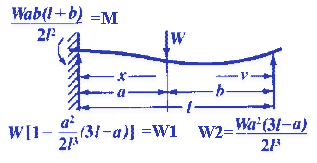
Calculating beam stress deflection is crucial in engineering to ensure structural integrity. The beam stress deflection equations calculator is a vital tool for determining the deflection and stress of a beam fixed at one end and supported at the other, with a load applied at any point. This calculator utilizes complex mathematical formulas to provide accurate results, taking into account the beam's length, material properties, and load characteristics. By using this calculator, engineers can optimize beam design and prevent potential failures, making it an essential resource for a wide range of applications. Accurate calculations are provided instantly.
- Beam Stress Deflection Equations Calculator for Beam Fixed at One End, Supported at the Other, Load at any Point
- Understanding the Beam Stress Deflection Equations Calculator for Beam Fixed at One End, Supported at the Other, Load at any Point
-
Frequently Asked Questions (FAQs)
- What is the purpose of the Beam Stress Deflection Equations Calculator for Beam Fixed at One End, Supported at the Other, Load at any Point?
- How do I use the Beam Stress Deflection Equations Calculator for Beam Fixed at One End, Supported at the Other, Load at any Point?
- What are the key assumptions and limitations of the Beam Stress Deflection Equations Calculator for Beam Fixed at One End, Supported at the Other, Load at any Point?
- How can I interpret the results of the Beam Stress Deflection Equations Calculator for Beam Fixed at One End, Supported at the Other, Load at any Point?
Beam Stress Deflection Equations Calculator for Beam Fixed at One End, Supported at the Other, Load at any Point
The Beam Stress Deflection Equations Calculator is a tool used to calculate the stress and deflection of a beam that is fixed at one end and supported at the other, with a load applied at any point. This calculator is useful for engineers and designers who need to determine the structural integrity of a beam under various loading conditions. The calculator takes into account the length of the beam, the load applied, and the material properties of the beam to calculate the maximum stress and deflection.
Introduction to Beam Stress Deflection Equations
The beam stress deflection equations are based on the beam theory, which assumes that the beam is a long, slender structure that is subject to bending and tension. The equations take into account the moment of inertia of the beam, the young's modulus of the material, and the load applied to the beam. The beam stress deflection equations are used to calculate the maximum stress and deflection of the beam, as well as the shear stress and torsional stress.
Types of Loads and Supports
There are several types of loads and supports that can be applied to a beam, including point loads, uniformly distributed loads, and moment loads. The type of load and support used can affect the stress and deflection of the beam. For example, a point load applied at the midpoint of a beam will result in a maximum stress at the midpoint, while a uniformly distributed load will result in a maximum stress at the supports.
Material Properties and Beam Geometry
The material properties of the beam, such as the young's modulus and poisson's ratio, can affect the stress and deflection of the beam. The beam geometry, including the length, width, and height, can also affect the stress and deflection. For example, a longer beam will result in a greater deflection than a shorter beam, while a wider beam will result in a lower stress than a narrower beam.
Calculations and Formulas
The calculations and formulas used to calculate the stress and deflection of a beam are based on the beam theory and the material properties of the beam. The formulas include the moment of inertia formula, the young's modulus formula, and the stress and deflection formulas. The calculations involve solving a system of differential equations to determine the maximum stress and deflection of the beam.
Applications and Limitations
The Beam Stress Deflection Equations Calculator has several applications in the field of engineering, including the design of buildings, bridges, and machinery. However, the calculator also has some limitations, including the assumption of a linear elastic material and the neglect of dynamic loads. The calculator is also sensitive to input values, and small changes in the input values can result in large changes in the output values.
| Property | Unit | Description |
|---|---|---|
| Length | m | The length of the beam |
| Load | N | The load applied to the beam |
| Young's Modulus | Pa | The young's modulus of the material |
| Moment of Inertia | m^4 | The moment of inertia of the beam |
| Maximum Stress | Pa | The maximum stress of the beam |
Understanding the Beam Stress Deflection Equations Calculator for Beam Fixed at One End, Supported at the Other, Load at any Point
The Beam Stress Deflection Equations Calculator is a powerful tool used to calculate the stress and deflection of a beam that is fixed at one end and supported at the other, with a load applied at any point. This calculator is widely used in the field of engineering, particularly in the design and analysis of beams and other structural elements. The calculator takes into account various parameters such as the length and thickness of the beam, the load applied, and the material properties of the beam.
Beam Theory and Calculations
The Beam Stress Deflection Equations Calculator is based on the beam theory, which describes the behavior of a beam under various types of loads. The calculator uses mathematical equations to calculate the stress and deflection of the beam, taking into account the boundary conditions and the loading conditions. The calculator can handle various types of loads, including point loads, uniformly distributed loads, and moment loads. The calculator also takes into account the material properties of the beam, such as the Young's modulus and the Poisson's ratio.
Types of Beams and Supports
The Beam Stress Deflection Equations Calculator can handle various types of beams and supports, including simply supported beams, fixed beams, and overhanging beams. The calculator can also handle various types of supports, including pin supports and roller supports. The calculator takes into account the boundary conditions of the beam, including the displacement and rotation of the beam at the supports. The calculator can also handle beams with varying cross-sectional areas and materials.
Load Calculation and Application
The Beam Stress Deflection Equations Calculator can handle various types of loads, including point loads, uniformly distributed loads, and moment loads. The calculator takes into account the magnitude and location of the load, as well as the direction of the load. The calculator can also handle loads that are applied at an angle to the beam. The calculator uses vector calculations to determine the resultant load and the load distribution along the beam.
Material Properties and Load Limits
The Beam Stress Deflection Equations Calculator takes into account the material properties of the beam, including the Young's modulus, Poisson's ratio, and yield strength. The calculator uses these properties to calculate the stress and deflection of the beam, as well as the load limits of the beam. The calculator can handle various types of materials, including metals, plastics, and composites. The calculator can also handle beams with varying material properties along the length of the beam.
Beam Deflection and Stress Analysis
The Beam Stress Deflection Equations Calculator provides a detailed analysis of the deflection and stress of the beam, including the maximum deflection and maximum stress. The calculator uses graphical displays to show the deflection and stress distribution along the beam, as well as the load distribution. The calculator can also handle dynamic loads and impact loads, and provides a detailed report of the beam analysis, including the results and recommendations for design improvements. The calculator is a powerful tool for engineers and designers to optimize the design of beams and other structural elements, and to ensure safe and reliable performance under various loading conditions.
Frequently Asked Questions (FAQs)
What is the purpose of the Beam Stress Deflection Equations Calculator for Beam Fixed at One End, Supported at the Other, Load at any Point?
The Beam Stress Deflection Equations Calculator is a powerful tool designed to calculate the stress and deflection of a beam that is fixed at one end and supported at the other, with a load applied at any point along its length. This calculator is essential for engineers and designers who need to determine the structural integrity of a beam under various loading conditions. By using this calculator, users can input the beam's dimensions, material properties, and loading conditions to obtain accurate calculations of the beam's stress and deflection. The calculator takes into account the boundary conditions of the beam, including the fixed and supported ends, to provide a comprehensive analysis of the beam's behavior under load. The results obtained from the calculator can be used to optimize the design of the beam, ensuring that it can withstand the applied loads and minimize the risk of failure.
How do I use the Beam Stress Deflection Equations Calculator for Beam Fixed at One End, Supported at the Other, Load at any Point?
To use the Beam Stress Deflection Equations Calculator, users need to input the required parameters, including the beam's length, width, and height, as well as the material's modulus of elasticity and Poisson's ratio. The user must also specify the loading conditions, including the magnitude and location of the load. Once the input parameters are entered, the calculator will perform the necessary calculations to determine the stress and deflection of the beam. The calculator uses complex algorithms and mathematical formulas to take into account the beam's geometry and material properties, as well as the loading conditions, to provide accurate results. The user can then review and analyze the results, which are typically presented in a table or graphical format, to gain a deeper understanding of the beam's behavior under load. By following these steps, users can quickly and easily use the calculator to evaluate the structural performance of a beam fixed at one end and supported at the other, with a load applied at any point.
What are the key assumptions and limitations of the Beam Stress Deflection Equations Calculator for Beam Fixed at One End, Supported at the Other, Load at any Point?
The Beam Stress Deflection Equations Calculator is based on several key assumptions and limitations, which users must understand to ensure accurate and reliable results. One of the primary assumptions is that the beam is a prismatic member with a constant cross-sectional area, and that the material is isotropic and linearly elastic. The calculator also assumes that the load is static and concentrated at a single point, and that the beam is subject to small deformations. Additionally, the calculator neglects the effects of shear deformation and rotary inertia, which can be significant in certain cases. Users must also be aware of the limitations of the calculator, including the accuracy of the input parameters and the validity of the underlying mathematical models. By understanding these assumptions and limitations, users can interpret the results of the calculator with caution and consider additional factors that may affect the structural behavior of the beam. It is also important to validate the results of the calculator by comparing them with experimental data or other analytical methods to ensure their accuracy and reliability.
How can I interpret the results of the Beam Stress Deflection Equations Calculator for Beam Fixed at One End, Supported at the Other, Load at any Point?
The results of the Beam Stress Deflection Equations Calculator provide a comprehensive analysis of the stress and deflection of the beam under the specified loading conditions. The stress results typically include the maximum stress and minimum stress values, as well as the stress distribution along the length of the beam. The deflection results include the maximum deflection and deflection distribution along the length of the beam. Users can interpret these results to determine the structural performance of the beam, including its ability to withstand the applied loads and resist failure. The results can also be used to identify potential weak points in the beam, such as areas of high stress concentration, and to optimize the design of the beam to minimize the risk of failure. Additionally, users can use the results to compare the performance of different beam designs or materials, and to evaluate the effects of variations in the loading conditions or boundary conditions. By carefully analyzing the results of the calculator, users can gain a deeper understanding of the behavior of the beam under load and make informed decisions about its design and application.
Deja una respuesta
Entradas Relacionadas