
Volume of Pyramid Frustrum Equation and Calculator

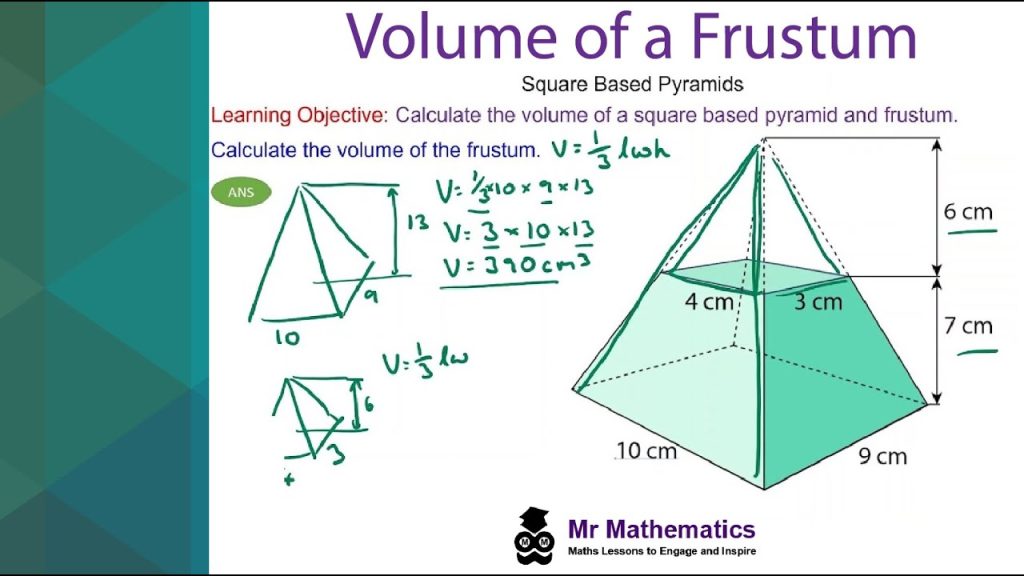
The volume of a pyramid frustum is a fundamental concept in geometry and engineering. A pyramid frustum is a solid shape formed by cutting a pyramid with a plane parallel to its base, resulting in a smaller pyramid being removed from the top. The volume of the remaining frustum can be calculated using a specific equation, which takes into account the heights and radii of the top and bottom bases. This article provides an in-depth look at the volume of pyramid frustum equation and offers a calculator to simplify the calculation process. The equation is crucial in various applications.
Understanding the Volume of Pyramid Frustum Equation and Calculator
The volume of a pyramid frustum is a fundamental concept in geometry and is used in various fields such as engineering, architecture, and design. A pyramid frustum is a three-dimensional shape formed by cutting a pyramid with a plane parallel to its base, resulting in a smaller pyramid being removed from the top. The equation for calculating the volume of a pyramid frustum is given by: V = (1/3)h(A1 + A2 + √(A1A2)), where V is the volume, h is the height, and A1 and A2 are the areas of the top and bottom bases.
What is a Pyramid Frustum?
A pyramid frustum is a three-dimensional shape with a polygonal base and four triangular faces that meet at the apex. The base of the frustum is a regular polygon, and the apex is a point. The height of the frustum is the perpendicular distance from the base to the apex.
How to Calculate the Volume of a Pyramid Frustum
To calculate the volume of a pyramid frustum, we need to know the height and the areas of the top and bottom bases. The equation for calculating the volume is given by: V = (1/3)h(A1 + A2 + √(A1A2)). We can also use a calculator to calculate the volume by plugging in the values of the height and the areas of the bases.
Applications of the Volume of Pyramid Frustum Equation
The volume of a pyramid frustum has numerous applications in various fields such as:
| Field | Application |
|---|---|
| Engineering | Designing buildings and bridges |
| Architecture | Designing monuments and sculptures |
| Design | Creating models and prototypes |
Derivation of the Volume of Pyramid Frustum Equation
The equation for calculating the volume of a pyramid frustum can be derived by using the method of similar triangles. By considering the similar triangles formed by the height and the radii of the top and bottom bases, we can derive the equation: V = (1/3)h(A1 + A2 + √(A1A2)).
Using a Calculator to Calculate the Volume of a Pyramid Frustum
A calculator can be used to calculate the volume of a pyramid frustum by plugging in the values of the height and the areas of the top and bottom bases. The calculator will then use the equation V = (1/3)h(A1 + A2 + √(A1A2)) to calculate the volume. This is a quick and accurate way to calculate the volume of a pyramid frustum, and is often used in engineering and design applications.
How do you find the volume of a frustum of a pyramid?

To find the volume of a frustum of a pyramid, you need to use a specific formula that takes into account the height and the areas of the bases. The formula for the volume of a frustum is given by V = (1/3)h(A1 + A2 + √(A1A2)), where h is the height of the frustum, and A1 and A2 are the areas of the bases.
Understanding the Formula
The formula for the volume of a frustum of a pyramid is based on the principle of similar triangles. To calculate the volume, you need to know the height of the frustum and the areas of the bases. The areas of the bases can be calculated using the formula for the area of a triangle or a rectangle, depending on the shape of the base. The key steps to calculate the volume are:
- Calculate the area of the bases using the formula for the area of a triangle or a rectangle.
- Calculate the height of the frustum.
- Plug the values into the formula for the volume of a frustum.
Calculating the Area of the Bases
To calculate the area of the bases, you need to know the length and width of the base. For a triangular base, the area can be calculated using the formula A = (1/2)bh, where b is the base and h is the height of the triangle. For a rectangular base, the area can be calculated using the formula A = lw, where l is the length and w is the width of the rectangle. The key steps to calculate the area of the bases are:
- Measure the length and width of the base.
- Use the formula for the area of a triangle or a rectangle to calculate the area.
- Plug the values into the formula for the volume of a frustum.
Understanding the Concept of Similar Triangles
The concept of similar triangles is used to derive the formula for the volume of a frustum. Similar triangles have the same shape but not necessarily the same size. The ratio of the corresponding sides of similar triangles is equal. The key steps to understand the concept of similar triangles are:
- Study the definition of similar triangles.
- Understand the properties of similar triangles.
- Apply the concept of similar triangles to derive the formula for the volume of a frustum.
Applying the Formula to Real-World Problems
The formula for the volume of a frustum can be applied to real-world problems such as calculating the volume of a pyramid or a cone. The key steps to apply the formula are:
- Identify the shape of the object.
- Measure the height and the areas of the bases.
- Plug the values into the formula for the volume of a frustum.
Simplifying the Calculation Process
To simplify the calculation process, you can use a calculator or a computer program to perform the calculations. You can also use online resources such as volume calculators to calculate the volume of a frustum. The key steps to simplify the calculation process are:
- Use a calculator or a computer program to perform the calculations.
- Use online resources such as volume calculators to calculate the volume.
- Check the results for accuracy.
What are the formulas of frustum of pyramid?
The formulas of a frustum of a pyramid are used to calculate its volume, surface area, and other properties. A frustum of a pyramid is a polyhedron formed by cutting a pyramid with a plane parallel to its base. The formulas for the frustum of a pyramid are as follows:
- The volume of a frustum of a pyramid is given by the formula: V = (1/3) h (A1 + A2 + sqrt(A1 A2)), where h is the height of the frustum, and A1 and A2 are the areas of the bases.
- The surface area of a frustum of a pyramid is given by the formula: SA = (A1 + A2) + (P1 + P2) sqrt(h^2 + (r2 - r1)^2), where P1 and P2 are the perimeters of the bases, and r1 and r2 are the radii of the bases.
Formulas for the Frustum of a Pyramid
The formulas for the frustum of a pyramid are used to calculate its volume, surface area, and other properties. The formulas are as follows:
- The volume of a frustum of a pyramid is given by the formula: V = (1/3) h (A1 + A2 + sqrt(A1 A2)), where h is the height of the frustum, and A1 and A2 are the areas of the bases.
- The surface area of a frustum of a pyramid is given by the formula: SA = (A1 + A2) + (P1 + P2) sqrt(h^2 + (r2 - r1)^2), where P1 and P2 are the perimeters of the bases, and r1 and r2 are the radii of the bases.
- The lateral surface area of a frustum of a pyramid is given by the formula: LSA = (P1 + P2) sqrt(h^2 + (r2 - r1)^2), where P1 and P2 are the perimeters of the bases, and r1 and r2 are the radii of the bases.
Calculating the Volume of a Frustum of a Pyramid
To calculate the volume of a frustum of a pyramid, we need to know the height of the frustum, and the areas of the bases. The formula for the volume of a frustum of a pyramid is V = (1/3) h (A1 + A2 + sqrt(A1 A2)), where h is the height of the frustum, and A1 and A2 are the areas of the bases. We can calculate the areas of the bases using the formula for the area of a circle: A = π r^2, where r is the radius of the base.
- Calculate the height of the frustum: h = height of the frustum.
- Calculate the areas of the bases: A1 = π r1^2, A2 = π r2^2, where r1 and r2 are the radii of the bases.
- Calculate the volume of the frustum using the formula: V = (1/3) h (A1 + A2 + sqrt(A1 A2)).
Calculating the Surface Area of a Frustum of a Pyramid
! to calculate the surface area of a frustum of a pyramid, we need to know the perimeters of the bases, and the radii of the bases. The formula for the surface area of a frustum of a pyramid is SA = (A1 + A2) + (P1 + P2) sqrt(h^2 + (r2 - r1)^2), where P1 and P2 are the perimeters of the bases, and r1 and r2 are the radii of the bases. We can calculate the perimeters of the bases using the formula for the perimeter of a circle: P = 2 π r, where r is the radius of the base.
- Calculate the perimeters of the bases: P1 = 2 π r1, P2 = 2 π r2, where r1 and r2 are the radii of the bases.
- Calculate the areas of the bases: A1 = π r1^2, A2 = π r2^2, where r1 and r2 are the radii of the bases.
- Calculate the surface area of the frustum using the formula: SA = (A1 + A2) + (P1 + P2) sqrt(h^2 + (r2 - r1)^2).
Properties of a Frustum of a Pyramid
A frustum of a pyramid has several properties that can be calculated using its formulas. Some of the properties of a frustum of a pyramid are:
- Volume: The volume of a frustum of a pyramid is given by the formula: V = (1/3) h (A1 + A2 + sqrt(A1 A2)), where h is the height of the frustum, and A1 and A2 are the areas of the bases.
- Surface Area: The surface area of a frustum of a pyramid is given by the formula: SA = (A1 + A2) + (P1 + P2) sqrt(h^2 + (r2 - r1)^2), where P1 and P2 are the perimeters of the bases, and r1 and r2 are the radii of the bases.
- Lateral Surface Area: The lateral surface area of a frustum of a pyramid is given by the formula: LSA = (P1 + P2)
Frequently Asked Questions (FAQs)
What is the Volume of Pyramid Frustum Equation and Calculator?
The Volume of Pyramid Frustum Equation is a mathematical formula used to calculate the volume of a pyramid frustum, which is a three-dimensional shape formed by cutting a pyramid with a plane parallel to its base. The equation is given by V = (1/3) h (A1 + A2 + sqrt(A1 A2)), where V is the volume, h is the height, and A1 and A2 are the areas of the top and bottom bases. This equation is a fundamental concept in geometry and is widely used in various fields such as engineering, architecture, and physics. The Calculator is a tool that uses this equation to compute the volume of a pyramid frustum, given the values of h, A1, and A2. It is a user-friendly and efficient way to calculate the volume, eliminating the need for manual calculations and reducing the chance of errors.
How to Use the Volume of Pyramid Frustum Calculator?
Using the Volume of Pyramid Frustum Calculator is a straightforward process that requires the input of three parameters: the height of the frustum, and the areas of the top and bottom bases. The user can enter these values in the input fields provided, and then click on the calculate button to obtain the volume. The calculator will instantly display the result, which can be copied or printed for further use. The calculator also includes validation checks to ensure that the input values are valid and consistent, preventing errors and inaccurate results. Additionally, the calculator provides detailed instructions and examples to help users understand how to use it correctly and effectively. By using the calculator, users can save time and effort, and focus on more complex tasks and challenging problems.
What are the Applications of the Volume of Pyramid Frustum Equation?
The Volume of Pyramid Frustum Equation has a wide range of applications in various fields, including engineering, architecture, physics, and mathematics. In engineering, the equation is used to calculate the volume of structures such as tanks, reservoirs, and buildings, which are often shaped like pyramid frustums. In architecture, the equation is used to design and analyze the stability and strength of buildings and bridges. In physics, the equation is used to study the properties of solids and liquids, such as density and buoyancy. In mathematics, the equation is used to model and analyze geometric shapes and patterns, and to develop new mathematical concepts and theories. The equation is also used in computer science to model and simulate 3D objects and environments, and in data analysis to calculate and visualize data.
What are the Limitations of the Volume of Pyramid Frustum Equation?
The Volume of Pyramid Frustum Equation is a powerful tool for calculating the volume of pyramid frustums, but it also has some limitations. One of the main limitations is that the equation assumes that the frustum is a regular pyramid, with straight and parallel sides. If the frustum is irregular, with curved or non-parallel sides, the equation may not provide an accurate result. Another limitation is that the equation requires the input of three parameters: the height and the areas of the top and bottom bases. If any of these parameters are unknown or uncertain, the equation may not be applicable. Additionally, the equation is sensitive to rounding errors and numerical instability, which can affect the accuracy of the result. Therefore, users should be aware of these limitations and use the equation with caution and care, and consider alternative methods or approximations when necessary.
Deja una respuesta
Entradas Relacionadas