
Conductive Heat Transfer Square Solid Equation and Calculator

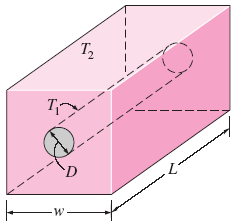
Conductive heat transfer is a fundamental concept in thermodynamics, where heat energy is transferred through a solid material without the movement of the material itself. The conductive heat transfer square solid equation is a mathematical model used to calculate the rate of heat transfer through a square solid. This equation takes into account the thermal conductivity of the material, the temperature difference, and the dimensions of the solid. The calculator provided will help users to easily compute the heat transfer rate, making it a valuable tool for engineers and researchers in various fields. It simplifies complex calculations.
- Conductive Heat Transfer Square Solid Equation and Calculator
- How do you calculate conductive heat transfer?
- What is the heat conduction equation for a solid?
- What is the equation for the heat transfer of a solid?
- What is the formula for the heat conduction through a solid cylinder?
-
Frequently Asked Questions (FAQs)
- What is Conductive Heat Transfer and How Does it Relate to the Square Solid Equation?
- How Does the Conductive Heat Transfer Square Solid Equation and Calculator Work?
- What are the Key Parameters that Affect Conductive Heat Transfer in a Square Solid Material?
- What are the Practical Applications of the Conductive Heat Transfer Square Solid Equation and Calculator?
Conductive Heat Transfer Square Solid Equation and Calculator
The conductive heat transfer square solid equation is a mathematical formula used to calculate the heat transfer rate through a square solid material. This equation is essential in various engineering applications, including the design of electronic devices, building insulation, and thermal management systems. The equation takes into account the material's thermal conductivity, cross-sectional area, and temperature difference to determine the heat transfer rate.
Introduction to Conductive Heat Transfer
Conductive heat transfer is the process by which heat is transferred through a solid material without the movement of the material itself. This type of heat transfer occurs due to the collision of neighboring atoms or molecules, which causes the energy to be transferred from one point to another. The conductive heat transfer equation is used to calculate the heat transfer rate through a square solid material, and it is given by the formula: Q = (k A) / L (T1 - T2), where Q is the heat transfer rate, k is the thermal conductivity of the material, A is the cross-sectional area, L is the length of the material, and T1 and T2 are the temperatures at the two ends of the material.
Thermal Conductivity and its Importance
Thermal conductivity is a measure of a material's ability to conduct heat. It is an essential property in determining the heat transfer rate through a material. Materials with high thermal conductivity, such as copper and aluminum, are good conductors of heat, while materials with low thermal conductivity, such as wood and plastic, are poor conductors of heat. The thermal conductivity of a material can be affected by various factors, including its composition, structure, and temperature.
Calculation of Heat Transfer Rate
The calculation of the heat transfer rate through a square solid material can be done using the conductive heat transfer equation. The equation requires the input of several parameters, including the thermal conductivity of the material, the cross-sectional area, the length of the material, and the temperatures at the two ends of the material. The following table shows the typical values of thermal conductivity for some common materials:
| Material | Thermal Conductivity (W/mK) |
|---|---|
| Copper | 386 |
| Aluminum | 237 |
| Wood | 0.1-0.2 |
| Plastic | 0.1-0.5 |
Applications of Conductive Heat Transfer
The conductive heat transfer equation has various applications in engineering and technology. Some of the notable applications include the design of electronic devices, such as computers and smartphones, where heat management is crucial to prevent overheating. Additionally, the equation is used in the design of building insulation, where thermal conductivity plays a significant role in determining the energy efficiency of a building.
Limitations and Assumptions
The conductive heat transfer equation has several limitations and assumptions. One of the main assumptions is that the material is homogeneous and isotropic, meaning that its thermal conductivity is the same in all directions. Additionally, the equation assumes that the heat transfer is steady-state, meaning that the temperature difference between the two ends of the material is constant. The equation also neglects the effects of convection and radiation, which can be significant in certain applications. Despite these limitations, the conductive heat transfer equation remains a powerful tool for calculating the heat transfer rate through a square solid material.
How do you calculate conductive heat transfer?
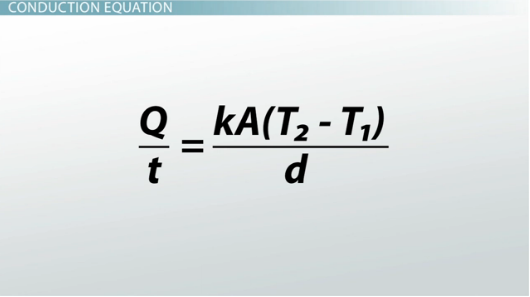
To calculate conductive heat transfer, you need to understand the concept of thermal conductivity, which is the ability of a material to conduct heat. The formula to calculate conductive heat transfer is Q = -kA(dT/dx), where Q is the heat flux, k is the thermal conductivity of the material, A is the cross-sectional area of the material, and dT/dx is the temperature gradient.
Understanding Thermal Conductivity
Thermal conductivity is a physical property of a material that describes its ability to conduct heat. The unit of thermal conductivity is Watts per meter-Kelvin (W/m-K). To calculate conductive heat transfer, you need to know the thermal conductivity of the material. Here are some key points to consider:
- The thermal conductivity of a material depends on its composition and structure.
- Metals have high thermal conductivity, while insulators have low thermal conductivity.
- The temperature of the material can also affect its thermal conductivity.
Calculating Heat Flux
The heat flux is the amount of heat transferred per unit area per unit time. To calculate the heat flux, you need to know the thermal conductivity of the material, the cross-sectional area of the material, and the temperature gradient. Here are some key points to consider:
- The heat flux is a vector quantity, which means it has both magnitude and direction.
- The temperature gradient is the change in temperature per unit distance.
- The cross-sectional area of the material is the area through which the heat is transferred.
Measuring Temperature Gradient
The temperature gradient is the change in temperature per unit distance. To measure the temperature gradient, you need to know the temperature at two or more points in the material. Here are some key points to consider:
- The temperature gradient can be measured using thermocouples or thermistors.
- The temperature gradient can be affected by the material's properties, such as its thermal conductivity and specific heat capacity.
- The temperature gradient can also be affected by external factors, such as convection and radiation.
Considering Cross-Sectional Area
The cross-sectional area of the material is the area through which the heat is transferred. To calculate the conductive heat transfer, you need to know the cross-sectional area of the material. Here are some key points to consider:
- The cross-sectional area can be calculated using the geometry of the material.
- The cross-sectional area can be affected by the material's shape and size.
- The cross-sectional area can also be affected by external factors, such as constriction or expansion.
Applications of Conductive Heat Transfer
Conductive heat transfer has many practical applications, including heating and cooling systems, thermal insulation, and electronics. Here are some key points to consider:
- Conductive heat transfer is used in heating and cooling systems to transfer heat from one location to another.
- Conductive heat transfer is used in thermal insulation to reduce heat transfer and conserve energy.
- Conductive heat transfer is used in electronics to dissipate heat and prevent overheating.
What is the heat conduction equation for a solid?
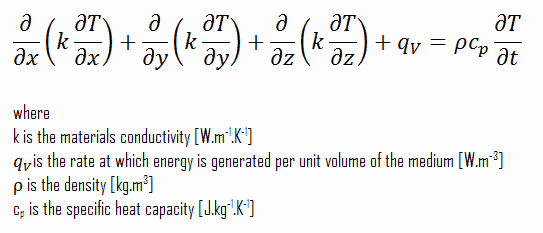
The heat conduction equation for a solid is a partial differential equation that describes the distribution of temperature within a solid material over time. It is based on the Fourier's law of conduction, which states that the heat flux is proportional to the temperature gradient. The heat conduction equation is given by:
∂u/∂t = α ∇²u,
where u is the temperature, t is time, α is the thermal diffusivity, and ∇² is the Laplacian operator.
Importance of Thermal Conductivity
The thermal conductivity of a solid is a measure of its ability to conduct heat. It is an important parameter in the heat conduction equation, as it determines the rate at which heat is transferred through the solid. A higher thermal conductivity means that the solid can transfer heat more efficiently. Some of the key factors that affect the thermal conductivity of a solid include:
- Crystal structure: The arrangement of atoms within the solid can affect its thermal conductivity.
- Temperature: The thermal conductivity of a solid can change with temperature.
- Impurities: The presence of impurities can reduce the thermal conductivity of a solid.
Boundary Conditions
The boundary conditions of a solid play a crucial role in determining the temperature distribution within the solid. There are three types of boundary conditions: Dirichlet, Neumann, and mixed. The Dirichlet boundary condition specifies the temperature on the boundary, while the Neumann boundary condition specifies the heat flux on the boundary. The mixed boundary condition is a combination of the Dirichlet and Neumann boundary conditions. Some of the key factors that affect the boundary conditions include:
- Surface roughness: The surface roughness of the solid can affect the boundary conditions.
- Contact resistance: The contact resistance between the solid and its surroundings can affect the boundary conditions.
- Convection: The convection of heat from the surface of the solid can affect the boundary conditions.
Mathematical Solution
The mathematical solution of the heat conduction equation involves separating the variables and using the separation of variables technique. This technique involves assuming that the temperature can be expressed as a product of two functions, one of which depends only on time and the other of which depends only on the spatial coordinates. Some of the key steps involved in the mathematical solution include:
- Separation of variables: The temperature is expressed as a product of two functions, one of which depends only on time and the other of which depends only on the spatial coordinates.
- Eigenvalue problem: The eigenvalue problem is solved to determine the eigenvalues and eigenfunctions of the Laplacian operator.
- Superposition: The eigenfunctions are superimposed to obtain the general solution of the heat conduction equation.
Physical Interpretation
The physical interpretation of the heat conduction equation is that it describes the diffusion of heat within a solid. The thermal diffusivity determines the rate at which heat is transferred through the solid. Some of the key factors that affect the physical interpretation include:
- Thermal energy: The thermal energy of the solid is transferred through the diffusion of heat.
- Temperature gradient: The temperature gradient drives the diffusion of heat through the solid.
- Heat flux: The heat flux is a measure of the rate at which heat is transferred through the solid.
Applications of Heat Conduction Equation
The heat conduction equation has numerous applications in various fields, including engineering, physics, and materials science. Some of the key applications include:
- Thermal management: The heat conduction equation is used to design thermal management systems for electronic devices.
- Heat exchangers: The heat conduction equation is used to design heat exchangers for power plants and chemical processing.
- Materials processing: The heat conduction equation is used to model the processing of materials, such as metals and polymers.
What is the equation for the heat transfer of a solid?
The equation for the heat transfer of a solid is given by the Fourier's Law, which states that the heat flux (q) is proportional to the temperature gradient (dT/dx) and the thermal conductivity (k) of the material. The equation is: q = -k dT/dx. This equation describes the conduction of heat through a solid material.
Temperature Gradient and Heat Transfer
The temperature gradient is a crucial factor in determining the heat transfer rate in a solid. A higher temperature gradient leads to a higher heat transfer rate. The temperature gradient is affected by the thermal conductivity of the material, as well as the geometric configuration of the solid. For example, a solid with a high thermal conductivity will have a lower temperature gradient, resulting in a lower heat transfer rate. Some key factors that affect the temperature gradient and heat transfer rate are:
- Thermal conductivity: The ability of a material to conduct heat.
- Geometric configuration: The shape and size of the solid.
- Temperature difference: The difference in temperature between two points in the solid.
Thermal Conductivity and Its Effects
The thermal conductivity of a material plays a significant role in determining the heat transfer rate. Materials with high thermal conductivity, such as metals, will have a higher heat transfer rate compared to materials with low thermal conductivity, such as insulators. The thermal conductivity of a material is affected by its microstructure and composition. For example, a material with a high concentration of impurities may have a lower thermal conductivity. Some key factors that affect the thermal conductivity of a material are:
- Microstructure: The arrangement of atoms and molecules in the material.
- Composition: The type and concentration of elements in the material.
- Impurities: The presence of foreign substances in the material.
Heat Transfer Mechanisms
There are several heat transfer mechanisms that occur in solids, including conduction, convection, and radiation. Conduction is the transfer of heat through direct contact between particles, while convection is the transfer of heat through the movement of fluids. Radiation is the transfer of heat through electromagnetic waves. The dominant heat transfer mechanism depends on the temperature of the solid and the surrounding environment. Some key factors that affect the heat transfer mechanism are:
- Temperature: The temperature of the solid and the surrounding environment.
- Fluid flow: The movement of fluids in the surrounding environment.
- Emittance: The ability of a surface to emit radiation.
Applications of Heat Transfer in Solids
The heat transfer equation has numerous applications in various fields, including engineering, physics, and materials science. For example, the equation is used to design heat exchangers, thermal management systems, and insulation materials. The equation is also used to predict the thermal performance of electronic devices, such as computers and smartphones. Some key applications of the heat transfer equation are:
- Heat exchangers: Devices that transfer heat from one fluid to another.
- Thermal management systems: Systems that regulate the temperature of electronic devices.
- Insulation materials: Materials that reduce heat transfer between two environments.
Numerical Methods for Solving Heat Transfer Equations
The heat transfer equation can be solved using numerical methods, such as the finite difference method and the finite element method. These methods involve discretizing the equation and solving the resulting system of equations using algorithms. The numerical solution can provide accurate and efficient results, especially for complex geometries and non-linear problems. Some key numerical methods for solving the heat transfer equation are:
- Finite difference method: A method that discretizes the equation using finite differences.
- Finite element method: A method that discretizes the equation using finite elements.
- Boundary element method: A method that discretizes the equation using boundary elements.
What is the formula for the heat conduction through a solid cylinder?

The formula for heat conduction through a solid cylinder is given by the equation: Q = (2 π k L (T1 - T2)) / ln(r2/r1), where Q is the heat transfer rate, k is the thermal conductivity of the material, L is the length of the cylinder, T1 and T2 are the temperatures at the inner and outer surfaces of the cylinder, and r1 and r2 are the inner and outer radii of the cylinder.
Understanding the Formula
The formula for heat conduction through a solid cylinder is based on the principle of heat transfer by conduction, which occurs due to the temperature difference between the inner and outer surfaces of the cylinder. The formula takes into account the thermal conductivity of the material, the length of the cylinder, and the radii of the inner and outer surfaces. To apply this formula, one needs to know the values of:
- The thermal conductivity of the material, which is a measure of its ability to conduct heat.
- The length of the cylinder, which affects the heat transfer rate.
- The radii of the inner and outer surfaces, which determine the surface area of the cylinder.
Assumptions and Limitations
The formula for heat conduction through a solid cylinder assumes that the cylinder is homogeneous and isotropic, meaning that its thermal conductivity is the same in all directions. It also assumes that the heat transfer is steady-state, meaning that the temperature difference between the inner and outer surfaces is constant. However, in reality, the thermal conductivity may vary with temperature, and the heat transfer may be transient, meaning that the temperature difference changes over time. To account for these limitations, one needs to consider:
- The temperature dependence of the thermal conductivity.
- The transient heat transfer effects, which can be modeled using differential equations.
- The boundary conditions, which can affect the heat transfer rate.
Applications and Examples
The formula for heat conduction through a solid cylinder has numerous applications in engineering and physics, such as in the design of heat exchangers, insulation systems, and thermal management systems. For example, in the design of a heat exchanger, one needs to calculate the heat transfer rate to determine the required surface area and thermal conductivity of the material. To do this, one can use:
- The formula for heat conduction through a solid cylinder to calculate the heat transfer rate.
- The properties of the material, such as its thermal conductivity and density.
- The geometric parameters, such as the length and radii of the cylinder.
Thermal Conductivity and Its Effects
The thermal conductivity of a material plays a crucial role in the heat conduction through a solid cylinder. Thermal conductivity is a measure of a material's ability to conduct heat, and it depends on the material's composition, structure, and temperature. Materials with high thermal conductivity, such as metals, are good heat conductors, while materials with low thermal conductivity, such as insulators, are poor heat conductors. The effects of thermal conductivity on heat conduction can be seen in:
- The heat transfer rate, which increases with thermal conductivity.
- The temperature distribution, which is affected by the thermal conductivity.
- The heat flux, which is proportional to the thermal conductivity.
Calculation and Modeling
Calculating the heat conduction through a solid cylinder requires a good understanding of the formula and its assumptions. One can use mathematical models, such as finite element methods, to simulate the heat transfer and temperature distribution in the cylinder. To do this, one needs to:
- Discretize the cylinder into smaller elements, such as finite elements.
- Apply the boundary conditions, such as the temperature and heat flux at the surfaces.
- Solve the governing equations, such as the heat equation, to obtain the temperature distribution and heat transfer rate.
Frequently Asked Questions (FAQs)
What is Conductive Heat Transfer and How Does it Relate to the Square Solid Equation?
Conductive heat transfer is the process by which heat is transferred through a material without the movement of the material itself. This type of heat transfer occurs due to the vibrations of atoms or molecules within the material, which causes the transfer of thermal energy from one point to another. The Square Solid Equation is a mathematical model used to calculate the conductive heat transfer in a square solid material. The equation takes into account the thermal conductivity of the material, the temperature difference between two points, and the thickness of the material. By using this equation, engineers and scientists can predict the amount of heat that will be transferred through a square solid material, which is essential in designing and optimizing thermal systems.
How Does the Conductive Heat Transfer Square Solid Equation and Calculator Work?
The Conductive Heat Transfer Square Solid Equation and Calculator is a mathematical tool used to calculate the conductive heat transfer in a square solid material. The equation is based on the Fourier's Law of heat conduction, which states that the heat flux is proportional to the temperature gradient and the thermal conductivity of the material. The calculator takes into account the input parameters such as the thermal conductivity, temperature difference, and thickness of the material, and calculates the heat transfer rate using the Square Solid Equation. The calculator also provides a graphical representation of the heat transfer rate, allowing users to visualize the results and make informed decisions. By using this calculator, users can quickly and accurately determine the conductive heat transfer in a square solid material, which is essential in a wide range of engineering applications.
What are the Key Parameters that Affect Conductive Heat Transfer in a Square Solid Material?
The conductive heat transfer in a square solid material is affected by several key parameters, including the thermal conductivity of the material, the temperature difference between two points, and the thickness of the material. The thermal conductivity is a measure of the material's ability to conduct heat, and it plays a crucial role in determining the heat transfer rate. The temperature difference is the driving force behind the heat transfer, and it determines the direction and magnitude of the heat flux. The thickness of the material also affects the heat transfer, as it determines the distance over which the heat must be transferred. Additionally, the boundary conditions of the material, such as the surface roughness and emissivity, can also impact the conductive heat transfer. By understanding the effects of these parameters, engineers and scientists can design and optimize thermal systems to achieve specific heat transfer requirements.
What are the Practical Applications of the Conductive Heat Transfer Square Solid Equation and Calculator?
The Conductive Heat Transfer Square Solid Equation and Calculator has a wide range of practical applications in various fields of engineering and science. One of the main applications is in the design and optimization of thermal systems, such as heat exchangers, insulation systems, and electronics cooling systems. The calculator can be used to determine the heat transfer rate and temperature distribution in these systems, allowing engineers to optimize their performance and efficiency. Another application is in the field of materials science, where the calculator can be used to study the thermal properties of various materials and their potential applications in different fields. The calculator can also be used in educational settings to teach students about the principles of conductive heat transfer and the application of mathematical models in real-world problems. By using the Conductive Heat Transfer Square Solid Equation and Calculator, users can gain a deeper understanding of the thermal behavior of materials and systems, and make informed decisions in a wide range of engineering applications.
Deja una respuesta
Entradas Relacionadas