
O-Ring Leak Rate Equation and Calculator

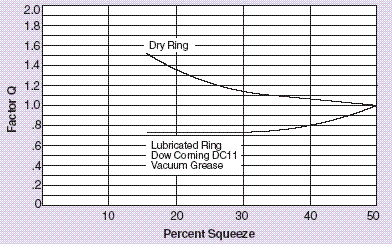
The O-Ring Leak Rate Equation and Calculator is a crucial tool for engineers and technicians working with sealing systems. An O-Ring's primary function is to prevent fluid or gas leaks in various applications, including aerospace, automotive, and industrial processes. However, determining the leak rate of an O-Ring can be complex, involving factors like pressure, temperature, and material properties. This article will delve into the O-Ring leak rate equation and provide a calculator to help professionals accurately predict and calculate leak rates, ensuring the integrity and safety of their systems. This knowledge is essential for optimal sealing performance.
- O-Ring Leak Rate Equation and Calculator
- What is the formula for leakage rate?
- What is the formula for seal leakage rate?
- How do you convert pressure drop to leak rate?
-
Frequently Asked Questions (FAQs)
- What is the O-Ring Leak Rate Equation and how is it used in practice?
- How does the O-Ring Leak Rate Calculator work and what inputs are required?
- What are the limitations and assumptions of the O-Ring Leak Rate Equation and Calculator?
- How can the O-Ring Leak Rate Equation and Calculator be used to optimize seal design and performance?
O-Ring Leak Rate Equation and Calculator
The O-Ring leak rate equation and calculator are essential tools used to determine the rate at which a fluid or gas leaks through an O-Ring seal. The equation takes into account various factors such as the seal's material, the fluid's viscosity, and the pressure difference across the seal. The calculator is a useful tool for engineers and technicians to quickly and accurately determine the leak rate of an O-Ring seal.
Introduction to O-Ring Leak Rate Equation
The O-Ring leak rate equation is a mathematical formula that calculates the rate at which a fluid or gas leaks through an O-Ring seal. The equation is based on the Darcy's law, which states that the flow rate of a fluid through a porous medium is proportional to the pressure difference across the medium and the cross-sectional area of the flow path.! The O-Ring leak rate equation is a modified version of Darcy's law, taking into account the unique properties of O-Ring seals.
Factors Affecting O-Ring Leak Rate
Several factors can affect the leak rate of an O-Ring seal, including the seal material, fluid viscosity, pressure difference, and temperature. The seal material can affect the leak rate by changing the permeability of the seal, while the fluid viscosity can affect the flow rate through the seal. The pressure difference across the seal can also impact the leak rate, as higher pressures can cause more fluid to flow through the seal. Temperature can also affect the leak rate, as changes in temperature can cause the seal material to expand or contract.
O-Ring Leak Rate Calculator
The O-Ring leak rate calculator is a tool used to quickly and accurately calculate the leak rate of an O-Ring seal. The calculator typically takes into account the seal dimensions, fluid properties, and operating conditions to determine the leak rate. The calculator can be used to determine the leak rate of an existing O-Ring seal or to design a new seal with a specific leak rate.
Applications of O-Ring Leak Rate Equation and Calculator
The O-Ring leak rate equation and calculator have a wide range of applications in various industries, including aerospace, automotive, and industrial manufacturing. The equation and calculator can be used to design and test O-Ring seals for high-pressure applications, high-temperature applications, and corrosive environments. The equation and calculator can also be used to troubleshoot O-Ring seal failures and to optimize seal design.
Limitations of O-Ring Leak Rate Equation and Calculator
While the O-Ring leak rate equation and calculator are useful tools, they have several limitations. The equation assumes that the seal is perfectly circular and that the fluid is incompressible, which may not always be the case. The calculator also requires accurate input data, which can be difficult to obtain in some cases. Additionally, the calculator may not account for non-linear effects or transient behavior, which can affect the accuracy of the results.
| Factor | Description |
|---|---|
| Seal Material | The material used to make the O-Ring seal, which can affect the leak rate |
| Fluid Viscosity | The measure of a fluid's resistance to flow, which can affect the leak rate |
| Pressure Difference | The difference in pressure across the O-Ring seal, which can affect the leak rate |
| Temperature | The temperature at which the O-Ring seal is operating, which can affect the leak rate |
What is the formula for leakage rate?
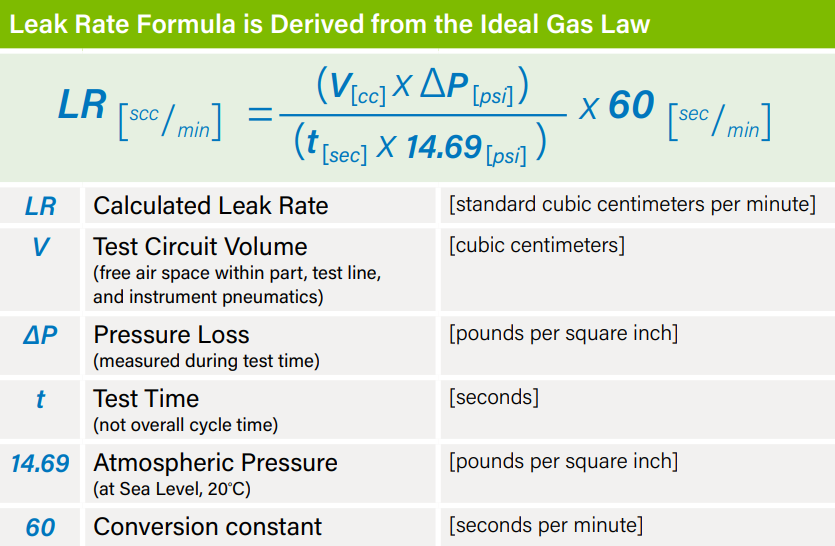
The formula for leakage rate is given by the equation: Q = (P1 - P2) / R, where Q is the leakage rate, P1 is the initial pressure, P2 is the final pressure, and R is the leakage resistance. This formula is used to calculate the rate at which a fluid or gas leaks from a container or system.
Understanding the Components of the Formula
The formula for leakage rate involves several key components, including the initial pressure and final pressure. These pressures are typically measured in units of pascals or atmospheres. The leakage resistance is also an important factor, as it determines how easily the fluid or gas can escape from the container or system. The main factors to consider when using this formula are:
- The type of fluid or gas being used, as this can affect the leakage rate
- The material of the container or system, as this can affect the leakage resistance
- The temperature and pressure conditions, as these can affect the leakage rate and leakage resistance
Calculating the Leakage Rate
To calculate the leakage rate, the initial pressure and final pressure must be measured, and the leakage resistance must be determined. This can be done using a variety of methods, including experimental testing and theoretical modeling. The key steps involved in calculating the leakage rate are:
- Determining the initial pressure and final pressure using pressure sensors or gauges
- Measuring the leakage resistance using experimental testing or theoretical modeling
- Plugging the values into the formula and solving for the leakage rate
Factors Affecting the Leakage Rate
The leakage rate can be affected by a variety of factors, including the type of fluid or gas, the material of the container or system, and the temperature and pressure conditions. Other factors that can affect the leakage rate include:
- The surface roughness of the container or system, as this can affect the leakage resistance
- The presence of defects or cracks in the container or system, as these can provide a path for the fluid or gas to escape
- The aging or degradation of the container or system, as this can affect the leakage resistance over time
Applications of the Leakage Rate Formula
The formula for leakage rate has a wide range of applications, including industrial processes, medical devices, and aerospace engineering. The key applications of this formula are:
- Designing and testing of containers and systems to ensure they meet safety and performance standards
- Predicting and preventing leaks in industrial processes, such as chemical plants and oil refineries
- Ensuring the integrity of medical devices, such as implantable devices and surgical instruments
Limitations and Future Developments
The formula for leakage rate has some limitations, including the assumption of a steady-state condition and the neglect of transient effects. Future developments in this area may include:
- Improving the accuracy and reliability of the formula by incorporating transient effects and non-linear behavior
- Developing new materials and technologies to reduce leakage and improve container and system performance
- Applying the formula to new fields and industries, such as energy and (environmental) applications
What is the formula for seal leakage rate?

The formula for seal leakage rate is typically calculated using the following equation: Q = (P1 - P2) / R, where Q is the leakage rate, P1 and P2 are the upstream and downstream pressures, and R is the leakage resistance. This formula is commonly used to determine the rate at which a seal is leaking, which is critical in various industries such as oil and gas, chemical processing, and power generation.
Understanding the Factors Affecting Seal Leakage Rate
The seal leakage rate is influenced by several factors, including the type of seal material, the surface roughness of the sealing surfaces, and the pressure and temperature conditions. To better understand these factors, consider the following:
- The seal material properties, such as its permeability and compressibility, can significantly impact the leakage rate.
- The surface roughness of the sealing surfaces can create leakage paths and increase the seal leakage rate.
- The pressure and temperature conditions can cause the seal material to degrade or change shape, leading to increased leakage.
Calculating Seal Leakage Rate Using the Formula
To calculate the seal leakage rate using the formula, it is essential to have accurate values for the upstream and downstream pressures and the leakage resistance. Consider the following steps:
- Determine the upstream and downstream pressures using pressure sensors or gauges.
- Calculate the leakage resistance using the seal material properties and the sealing surface characteristics.
- Plug in the values into the formula and solve for the leakage rate.
Importance of Seal Leakage Rate in Industrial Applications
The seal leakage rate is a critical parameter in various industrial applications, including pumps, compressors, and turbines. Consider the following:
- A high seal leakage rate can lead to energy losses, reduced efficiency, and increased maintenance costs.
- A low seal leakage rate can result in improved safety, reduced emissions, and increased reliability.
- Accurate seal leakage rate calculations can help optimize the seal design and material selection for specific applications.
Common Challenges in Measuring Seal Leakage Rate
Measuring the seal leakage rate can be challenging due to various factors, including instrumentation limitations and experimental errors. Consider the following:
- The pressure sensors or gauges used to measure the upstream and downstream pressures may have limited accuracy or resolution.
- The leakage resistance calculation may be complex and require sophisticated models or numerical methods.
- The experimental setup may be difficult to replicate, leading to inconsistent or inaccurate results.
Advanced Methods for Seal Leakage Rate Prediction
Advanced methods, such as computational fluid dynamics (CFD) and finite element analysis (FEA), can be used to predict the seal leakage rate with high accuracy. Consider the following:
- CFD can simulate the fluid flow and pressure distribution within the seal to predict the leakage rate.
- FEA can model the mechanical behavior of the seal material and the sealing surface to predict the leakage resistance.
- These advanced methods can help optimize the seal design and material selection for specific applications and reduce the need for experimental testing.
How do you convert pressure drop to leak rate?
To convert pressure drop to leak rate, you need to use the orifice equation or the leak rate equation, which relates the pressure difference across a leak to the flow rate of the fluid escaping through the leak. The leak rate is typically expressed in units of volume per unit time, such as standard cubic feet per minute (SCFM) or liters per second (L/s). The pressure drop is typically expressed in units of pounds per square inch (PSI) or pascals (Pa).
Understanding the Orifice Equation
The orifice equation is a fundamental equation in fluid dynamics that describes the relationship between the pressure drop and the flow rate through a leak. The equation is given by: Q = C A sqrt(2 ΔP / ρ), where Q is the flow rate, C is the discharge coefficient, A is the area of the leak, ΔP is the pressure drop, and ρ is the density of the fluid. To apply this equation, you need to know the following:
- The type of fluid involved, such as air or water, to determine the density.
- The size and shape of the leak, to determine the area.
- The pressure drop across the leak, to determine the driving force for the flow.
Factors Affecting Leak Rate Conversion
Several factors can affect the conversion of pressure drop to leak rate, including the type of fluid, the size and shape of the leak, and the temperature and pressure conditions. For example, the viscosity of the fluid can affect the leak rate, with more viscous fluids resulting in lower leak rates. Additionally, the surface roughness of the leak can also affect the leak rate, with smoother surfaces resulting in higher leak rates. To account for these factors, you can use the following:
- Fluid properties, such as viscosity and density, to determine the leak rate.
- Leak characteristics, such as size and shape, to determine the area and perimeter of the leak.
- Operating conditions, such as temperature and pressure, to determine the driving force for the flow.
Leak Rate Measurement Techniques
There are several techniques for measuring leak rates, including pressure decay, flow metering, and ultrasonic detection. The pressure decay method involves measuring the pressure drop over time and using the orifice equation to calculate the leak rate. The flow metering method involves measuring the flow rate directly using a flow meter. The ultrasonic detection method involves using ultrasonic sensors to detect the sound waves emitted by the leak. To choose the best technique, consider the following:
- The type of fluid involved, such as gas or liquid, to determine the measurement technique.
- The size and shape of the leak, to determine the measurement technique.
- The accuracy and precision required, to determine the measurement technique.
Applications of Leak Rate Conversion
The conversion of pressure drop to leak rate has several practical applications, including leak detection and leak repair in pipelines, tanks, and vessels. It is also used in quality control and testing of products and systems, such as valves, fittings, and seals. To apply this conversion, you need to know the following:
- The type of system involved, such as pneumatic or hydraulic, to determine the leak rate.
- The operating conditions, such as temperature and pressure, to determine the driving force for the flow.
- The acceptable leak rate, to determine the action limit for leak repair.
Limitations and Uncertainties
There are several limitations and uncertainties associated with the conversion of pressure drop to leak rate, including errors in measurement and calculation, and uncertainties in fluid properties and leak characteristics. To minimize these limitations, you can use the following:
- High-accuracy measurements of pressure drop and flow rate to minimize errors.
- Robust calculation methods, such as numerical simulation, to account for complexities in fluid flow.
- Experimental validation of leak rate measurements to confirm accuracy and precision.
Frequently Asked Questions (FAQs)
What is the O-Ring Leak Rate Equation and how is it used in practice?
The O-Ring Leak Rate Equation is a mathematical formula used to calculate the rate at which a fluid or gas leaks through a seal, specifically an O-ring. This equation takes into account various factors such as the pressure difference across the seal, the temperature of the system, and the materials used for the O-ring and the surrounding surfaces. The equation is commonly used in industries where sealing is critical, such as in aerospace, automotive, and chemical processing. By using the O-Ring Leak Rate Equation, engineers and designers can predict the likelihood of leaks and design more effective sealing systems. The equation is also useful for troubleshooting existing sealing issues and identifying potential failure modes. Additionally, the equation can be used to compare the performance of different O-ring materials and designs, allowing for the selection of the most suitable option for a particular application.
How does the O-Ring Leak Rate Calculator work and what inputs are required?
The O-Ring Leak Rate Calculator is a tool that uses the O-Ring Leak Rate Equation to calculate the leak rate of a seal. The calculator typically requires several inputs, including the inner diameter and outer diameter of the O-ring, the pressure difference across the seal, the temperature of the system, and the permeability of the O-ring material. The calculator may also require information about the surface roughness of the surrounding surfaces and the compressibility of the fluid or gas. Once these inputs are entered, the calculator uses the O-Ring Leak Rate Equation to calculate the leak rate, which is typically expressed in units of volume per unit time. The calculator may also provide additional information, such as the leak rate coefficient and the effective diffusion coefficient, which can be used to further analyze the sealing system. The O-Ring Leak Rate Calculator is a useful tool for engineers and designers, as it allows them to quickly and easily calculate the leak rate of a seal and make informed decisions about seal design and material selection.
What are the limitations and assumptions of the O-Ring Leak Rate Equation and Calculator?
The O-Ring Leak Rate Equation and Calculator are based on several assumptions and simplifications, which can limit their accuracy and applicability. One major assumption is that the O-ring is perfectly circular and uniformly compressed, which may not always be the case in practice. Additionally, the equation assumes that the fluid or gas is ideal and incompressible, which may not be true for all applications. The equation also assumes that the surface roughness of the surrounding surfaces is uniform and isotropic, which can affect the accuracy of the calculation. Furthermore, the calculator may not account for non-linear effects, such as viscoelasticity and plasticity, which can occur in certain materials and operating conditions. As a result, the O-Ring Leak Rate Equation and Calculator should be used with caution and in conjunction with experimental testing and validation to ensure accurate and reliable results. It is also important to consider the uncertainty and sensitivity of the calculation, as small changes in the inputs can result in large changes in the output.
How can the O-Ring Leak Rate Equation and Calculator be used to optimize seal design and performance?
The O-Ring Leak Rate Equation and Calculator can be used to optimize seal design and performance by providing a quantitative understanding of the factors that affect leak rate. By using the equation and calculator, engineers and designers can simulate the performance of different seal designs and materials, and predict the effects of changes in operating conditions. This can help to identify the most critical factors affecting seal performance and optimize the design to minimize leak rate. For example, the equation and calculator can be used to evaluate the effects of different O-ring materials and geometries on leak rate, and to select the most suitable option for a particular application. Additionally, the equation and calculator can be used to investigate the effects of surface roughness and compressibility on seal performance, and to develop strategies to mitigate these effects. By using the O-Ring Leak Rate Equation and Calculator, engineers and designers can develop more effective and reliable sealing systems, which can help to improve the safety, efficiency, and performance of a wide range of industrial and commercial applications.
Deja una respuesta
Entradas Relacionadas