
API Gravity Equations and Calculator


The API Gravity is a measure of the density of a liquid petroleum product, with higher values indicating lower densities. This parameter is crucial in the oil and gas industry, as it helps to determine the quality and characteristics of petroleum products. The API Gravity can be calculated using various equations, which take into account the density of the liquid at specific temperatures. This article provides an overview of the API Gravity equations and offers a calculator to simplify the calculation process, making it easier to determine the API Gravity of different petroleum products. Accurate calculations are essential.
Understanding API Gravity Equations and Calculator
The API Gravity is a measure of the density of a crude oil or refined product, and it is an essential parameter in the petroleum industry. The API Gravity is defined as the density of the liquid at 60°F (15.56°C) compared to the density of water at the same temperature. The API Gravity is used to determine the quality of crude oil and refined products, and it is also used to calculate the volume of oil in a tank.
What is API Gravity?
The API Gravity is a dimensionless quantity that is calculated using the following formula: API Gravity = (141.5 / density at 60°F) - 131.5. The density of the liquid is measured in units of g/cm³ or kg/m³. The API Gravity scale ranges from 0 to 100, with higher values indicating a lower density. For example, a crude oil with an API Gravity of 35 has a density of approximately 0.85 g/cm³.
Importance of API Gravity in the Petroleum Industry
The API Gravity is a critical parameter in the petroleum industry because it affects the quality and value of crude oil and refined products. Crude oils with higher API Gravity values are generally more valuable because they are easier to refine and produce more valuable products. The API Gravity is also used to determine the amount of oil in a tank, which is essential for inventory management and custody transfer.
API Gravity Equations and Calculations
The API Gravity can be calculated using the following equation: API Gravity = (141.5 / density at 60°F) - 131.5. This equation can be rearranged to calculate the density of the liquid at 60°F: density at 60°F = 141.5 / (API Gravity + 131.5). The API Gravity can also be used to calculate the volume of oil in a tank using the following equation: volume = (mass / density at 60°F) (1 + (temperature - 60°F) coefficient of expansion).
API Gravity Calculator
An API Gravity Calculator is a tool that can be used to calculate the API Gravity of a crude oil or refined product. The calculator typically requires the input of the density of the liquid at 60°F and the temperature of the liquid. The calculator then uses the API Gravity equation to calculate the API Gravity of the liquid. The calculator can also be used to calculate the volume of oil in a tank using the API Gravity and the mass of the oil!
Applications of API Gravity
The API Gravity has several applications in the petroleum industry, including:
| Application | Description |
|---|---|
| Crude Oil Quality | The API Gravity is used to determine the quality of crude oil, with higher values indicating a more valuable crude oil. |
| Refined Product Quality | The API Gravity is used to determine the quality of refined products, such as gasoline and diesel fuel. |
| Inventory Management | The API Gravity is used to determine the amount of oil in a tank, which is essential for inventory management and custody transfer. |
| Oil Pricing | The API Gravity is used to determine the price of crude oil and refined products, with higher values indicating a more valuable product. |
| Refinery Optimization | The API Gravity is used to optimize refinery operations, including the selection of crude oil feedstocks and the optimization of refining processes. |
How to calculate SG from API?

To calculate the Specific Gravity (SG) from the American Petroleum Institute (API) gravity, you can use the following formula: SG = 141.5 / (131.9 + API). This formula is widely used in the petroleum industry to convert between API gravity and specific gravity.
Understanding API Gravity
The API gravity is a measure of the density of a liquid petroleum product, such as crude oil or refined products. It is expressed in degrees API, which is a rough measure of the product's density relative to water. The API gravity is an important parameter in the petroleum industry, as it affects the behavior and properties of the product. Some of the key points to consider when understanding API gravity are:
- The API gravity is measured using a hydrometer, which is a device that measures the density of a liquid.
- The API gravity is expressed in degrees API, which is a scale that ranges from 0 to 100.
- A higher API gravity indicates a lower density, while a lower API gravity indicates a higher density.
Converting API to Specific Gravity
Converting API gravity to specific gravity is a straightforward process using the formula: SG = 141.5 / (131.9 + API). This formula is based on the definition of specific gravity, which is the ratio of the density of a substance to the density of water. Some of the key points to consider when converting API to specific gravity are:
- The formula is applicable to liquids only, and not to gases or solids.
- The API gravity must be expressed in degrees API, which is a measure of the density of the liquid relative to water.
- The resulting specific gravity is a dimensionless quantity that represents the ratio of the density of the liquid to the density of water.
Importance of Specific Gravity in Petroleum Industry
The specific gravity is an important parameter in the petroleum industry, as it affects the behavior and properties of petroleum products. Some of the key points to consider when understanding the importance of specific gravity in the petroleum industry are:
- The specific gravity affects the viscosity and flowability of petroleum products.
- The specific gravity is used to calculate the volume and weight of petroleum products.
- The specific gravity is an important parameter in the design and operation of petroleum processing equipment.
Calculating API from Specific Gravity
To calculate the API gravity from the specific gravity, you can use the following formula: API = (141.5 / SG) - 131.9. This formula is the inverse of the formula used to convert API to specific gravity. Some of the key points to consider when calculating API from specific gravity are:
- The specific gravity must be expressed as a dimensionless quantity, which represents the ratio of the density of the liquid to the density of water.
- The resulting API gravity is expressed in degrees API, which is a measure of the density of the liquid relative to water.
- The formula is applicable to liquids only, and not to gases or solids.
Applications of API and Specific Gravity
The API gravity and specific gravity have several applications in the petroleum industry, including petroleum refining, petroleum production, and petroleum transportation. Some of the key points to consider when understanding the applications of API and specific gravity are:
- The API gravity and specific gravity are used to characterize and classify petroleum products.
- The API gravity and specific gravity are used to design and operate petroleum processing equipment.
- The API gravity and specific gravity are used to predict the behavior and properties of petroleum products under different conditions.
What is 141.5 and 131.5 in API gravity formula calculator?
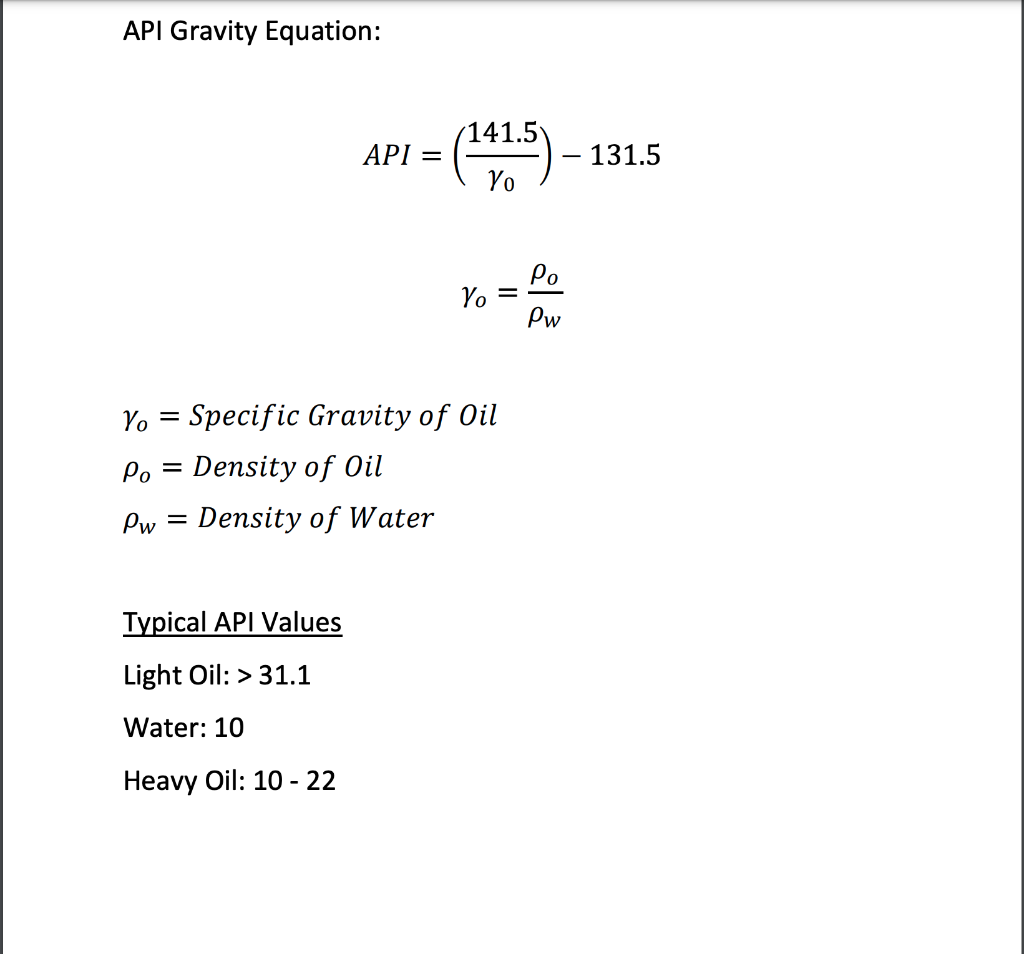
The API gravity formula calculator is a tool used to determine the density of a liquid, specifically crude oil, based on its API gravity. The numbers 141.5 and 131.5 are constants used in the calculation. The formula is as follows: API Gravity = (141.5 / Specific Gravity) - 131.5. These constants are used to convert the specific gravity of a liquid to its corresponding API gravity.
Introduction to API Gravity Formula
The API gravity formula is a widely used standard in the petroleum industry to express the density of crude oil and other liquids. The formula is based on the specific gravity of the liquid, which is the ratio of its density to the density of water. The constants 141.5 and 131.5 are used to convert this ratio to a more convenient scale. Here are some key points to consider:
- The API gravity scale is inversely related to the density of the liquid, meaning that higher API gravity values correspond to lower densities.
- The specific gravity of a liquid is a critical component of the API gravity calculation, and it is typically measured using a hydrometer or other density measurement device.
- The API gravity formula is a simple and convenient way to express the density of a liquid, and it is widely used in the petroleum industry for crude oil and other petroleum products.
Understanding the Constants 141.5 and 131.5
The constants 141.5 and 131.5 are used in the API gravity formula to convert the specific gravity of a liquid to its corresponding API gravity. These constants are based on the density of water, which is defined as 1 g/cm³ or 1000 kg/m³. The constant 141.5 is used to scale the specific gravity to a more convenient range, while the constant 131.5 is used to shift the scale to a more intuitive range. Here are some key points to consider:
- The constant 141.5 is used to scale the specific gravity to a range that is more convenient for calculation and comparison.
- The constant 131.5 is used to shift the scale to a range that is more intuitive and easy to understand.
- The use of these constants allows for a simple and convenient way to express the density of a liquid, and they are widely used in the petroleum industry.
Calculating API Gravity
To calculate the API gravity of a liquid, you need to know its specific gravity. This can be measured using a hydrometer or other density measurement device. Once you have the specific gravity, you can plug it into the API gravity formula to get the corresponding API gravity value. Here are some key points to consider:
- The specific gravity of a liquid is a critical component of the API gravity calculation, and it is typically measured using a hydrometer or other density measurement device.
- The API gravity formula is a simple and convenient way to express the density of a liquid, and it is widely used in the petroleum industry.
- The API gravity value can be used to determine the density of a liquid, and it is an important parameter in the petroleum industry.
Importance of API Gravity in Petroleum Industry
The API gravity is an important parameter in the petroleum industry, as it is used to determine the density of crude oil and other petroleum products. This information is critical for a variety of applications, including refining, transportation, and storage. Here are some key points to consider:
- The API gravity is an important parameter in the petroleum industry, as it is used to determine the density of crude oil and other petroleum products.
- The API gravity value can be used to determine the yield of different petroleum products, such as gasoline, diesel, and jet fuel.
- The API gravity is also used to determine the viscosity of a liquid, which is an important parameter in the petroleum industry.
Applications of API Gravity Formula Calculator
The API gravity formula calculator has a variety of applications in the petroleum industry, including crude oil and petroleum products. The calculator can be used to determine the density of a liquid, as well as its API gravity value. Here are some key points to consider:
- The API gravity formula calculator is a convenient and easy-to-use tool for determining the density of a liquid.
- The calculator can be used to determine the API gravity value of a liquid, which is an important parameter in the petroleum industry.
- The API gravity formula calculator is widely used in the petroleum industry for a variety of applications, including refining, transportation, and storage.
What is the API gravity rule?

The API gravity rule is a standard method used to measure the density of crude oil and other petroleum products. It is defined by the American Petroleum Institute (API) and is widely used in the oil industry. The API gravity is calculated using a hydrometer, which is a device that measures the density of a liquid. The API gravity is then used to determine the weight and volume of the oil, which is essential for calculating the price and quantity of the oil being bought or sold.
What is API Gravity Used For?
The API gravity rule is used for a variety of purposes, including calculating the density and weight of crude oil and other petroleum products. It is also used to determine the quality and characteristics of the oil, such as its viscosity and sulfur content. Some of the key uses of API gravity include:
- Determining the price of crude oil and other petroleum products
- Calculating the quantity of oil being bought or sold
- Assessing the quality and characteristics of the oil
How is API Gravity Measured?
The API gravity is measured using a hydrometer, which is a device that measures the density of a liquid. The hydrometer is calibrated to read the API gravity directly, and the measurement is usually taken at a temperature of 60°F (15.6°C). The API gravity is calculated using the following formula: API gravity = (141.5 / specific gravity) - 131.5. Some of the key factors that can affect the measurement of API gravity include:
- Temperature of the oil
- Pressure of the oil
- Contamination of the oil with other substances
What are the Benefits of Using API Gravity?
The use of API gravity has several benefits, including providing a standardized method for measuring the density of crude oil and other petroleum products. It also allows for the accurate calculation of the weight and volume of the oil, which is essential for calculating the price and quantity of the oil being bought or sold. Some of the key benefits of using API gravity include:
- Improved accuracy in calculating the weight and volume of oil
- Increased efficiency in the buying and selling of oil
- Enhanced transparency in the oil market
What are the Limitations of API Gravity?
While API gravity is a widely used and accepted method for measuring the density of crude oil and other petroleum products, it has some limitations. For example, it is not suitable for measuring the density of highly viscous or highly dense liquids. Additionally, the temperature and pressure of the oil can affect the measurement of API gravity. Some of the key limitations of API gravity include:
- Limited range of measurement
- Sensitivity to temperature and pressure
- Not suitable for highly viscous or dense liquids
How is API Gravity Used in the Oil Industry?
The API gravity rule is widely used in the oil industry for a variety of purposes, including calculating the price and quantity of crude oil and other petroleum products. It is also used to determine the quality and характеристики of the oil, such as its viscosity and sulfur content. Some of the key ways that API gravity is used in the oil industry include:
- Buying and selling of crude oil and other petroleum products
- Calculating the value of oil reserves
- Assessing the quality of oil for refining and processing
Frequently Asked Questions (FAQs)
What is API Gravity and how is it calculated?
API Gravity is a measure of the density of a fluid, typically petroleum products, and is calculated using a specific formula. The American Petroleum Institute (API) gravity is defined as the ratio of the density of the fluid to the density of water at a reference temperature. The formula for calculating API gravity is: API Gravity = (141.5 / Specific Gravity) - 131.5, where Specific Gravity is the ratio of the density of the fluid to the density of water. This formula is widely used in the petroleum industry to characterize the properties of various petroleum products. The API Gravity is an important parameter in the characterization of crude oils and refined products, as it affects their behavior and performance in different applications.
What are the different types of API Gravity Equations and Calculators?
There are several types of API gravity equations and calculators available, each with its own limitations and advantages. The most common equation is the API Gravity Formula, which is a simple and accurate method for calculating API gravity. However, this formula assumes that the density of the fluid is constant, which is not always the case. Other equations, such as the Bernstein Equation and the McCain Equation, take into account the effects of temperature and pressure on the density of the fluid. These equations are more complex and require more input data, but provide more accurate results. Calculators, on the other hand, are software programs that can perform these calculations quickly and efficiently, using algorithms and databases to provide accurate results.
How do API Gravity Equations and Calculators affect the petroleum industry?
API gravity equations and calculators have a significant impact on the petroleum industry, as they are used to characterize and evaluate the properties of petroleum products. The API Gravity is an important parameter in the pricing and trading of crude oils and refined products, as it affects their value and quality. Refineries use API Gravity to optimize their processes and improve the yield and quality of their products. Pipeline operators use API Gravity to determine the flow rate and pressure of their pipelines, and to predict the behavior of the fluid under different conditions. Regulatory agencies also use API Gravity to monitor and enforce environmental and safety regulations.
What are the limitations and future developments of API Gravity Equations and Calculators?
Despite their widespread use, API gravity equations and calculators have several limitations. One of the main limitations is that they are based on empirical correlations and do not take into account the fundamental physics of the fluid behavior. This can lead to inaccuracies and uncertainties in the results, particularly for complex and non-Newtonian fluids. Another limitation is that they are sensitive to errors in the input data, which can propagate and amplify through the calculations. Future developments in API gravity equations and calculators are likely to focus on improving their accuracy and robustness, using advanced mathematical models and computational methods, such as machine learning and artificial intelligence. Additionally, there is a growing interest in developing new equations and calculators that can handle the complexities of unconventional and alternative energy sources, such as biofuels and renewable energy sources.
Deja una respuesta
Entradas Relacionadas