
Aerodynamic Drag Equation and Calculator


The Aerodynamic Drag Equation is a fundamental concept in physics and engineering, describing the force opposing an object's motion through a fluid, such as air or water. This equation is crucial in designing and optimizing vehicles, aircraft, and other objects that move through fluids. The drag equation takes into account factors like velocity, density, and cross-sectional area, providing a mathematical model to predict and calculate the drag force. An online calculator can simplify this process, allowing users to easily compute and analyze the effects of drag on various objects and systems. Accurate calculations are essential for efficiency.
- Aerodynamic Drag Equation and Calculator: Understanding the Fundamentals
- What is the formula for aerodynamic drag?
- What is the CD formula in aerodynamics?
- How is aerodynamic drag measured?
- What is the formula for the drag coefficient NASA?
-
Frequently Asked Questions (FAQs)
- Aerodynamic Drag Equation and Calculator: What is the purpose of the drag equation in aerodynamics?
- How does the Aerodynamic Drag Equation and Calculator work?
- What are the key factors that affect the Aerodynamic Drag Equation and Calculator?
- How can the Aerodynamic Drag Equation and Calculator be applied in real-world scenarios?
Aerodynamic Drag Equation and Calculator: Understanding the Fundamentals
The Aerodynamic Drag Equation is a mathematical formula used to calculate the drag force exerted on an object moving through a fluid, such as air or water. This equation is crucial in various fields, including aerospace engineering, automotive engineering, and wind engineering. The drag equation is given by: F_d = ½ ρ v^2 C_d A, where F_d is the drag force, ρ is the air density, v is the velocity of the object, C_d is the drag coefficient, and A is the cross-sectional area of the object.
Introduction to Aerodynamic Drag
Aerodynamic drag is the force that opposes the motion of an object through the air. It is caused by the interaction between the object and the air molecules around it. The drag force depends on several factors, including the shape and size of the object, its velocity, and the air density. Understanding aerodynamic drag is essential for designing and optimizing vehicles, aircraft, and other objects that move through the air.
Key Components of the Aerodynamic Drag Equation
The aerodynamic drag equation consists of several key components, including the air density, velocity, drag coefficient, and cross-sectional area. The air density is a measure of the mass of air per unit volume, while the velocity is the speed at which the object is moving. The drag coefficient is a dimensionless value that depends on the shape and size of the object, and the cross-sectional area is the area of the object perpendicular to the direction of motion.
Aerodynamic Drag Calculator: How it Works
An aerodynamic drag calculator is a tool used to calculate the drag force exerted on an object moving through the air. It typically requires input values such as the air density, velocity, drag coefficient, and cross-sectional area. The calculator then uses the drag equation to calculate the drag force. Some calculators may also provide additional features, such as the ability to calculate the power required to overcome the drag force or the efficiency of the object.
Applications of the Aerodynamic Drag Equation
The aerodynamic drag equation has a wide range of applications in various fields, including aerospace engineering, automotive engineering, and wind engineering. It is used to design and optimize vehicles, aircraft, and other objects that move through the air. For example, in aerospace engineering, the drag equation is used to calculate the drag force on an aircraft, which is essential for determining its fuel efficiency and range.
Limitations and Assumptions of the Aerodynamic Drag Equation
The aerodynamic drag equation is based on several assumptions and limitations, including the assumption of a steady flow and a laminar flow. It also assumes that the object is moving at a constant velocity and that the air density is uniform. In reality, these assumptions may not always be valid, and the equation may need to be modified to account for turbulent flow or compressible flow.
| Variable | Definition | Units |
|---|---|---|
| F_d | Drag force | N (Newtons) |
| ρ | Air density | kg/m^3 (kilograms per cubic meter) |
| v | Velocity | m/s (meters per second) |
| C_d | Drag coefficient | Unitless |
| A | Cross-sectional area | m^2 (square meters) |
What is the formula for aerodynamic drag?
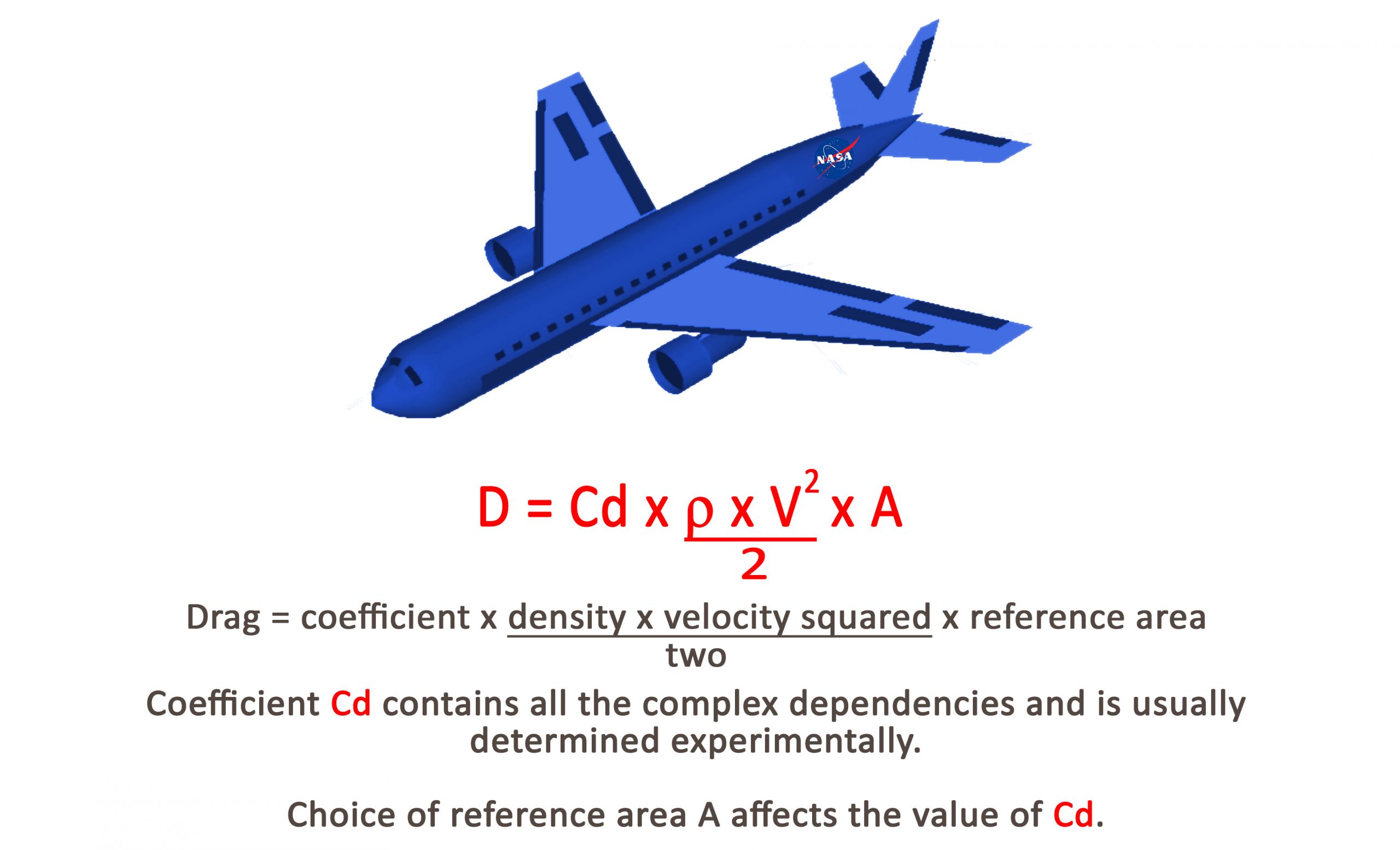
The formula for aerodynamic drag is given by the equation:
D = ½ × ρ × v^2 × Cd × A
where D is the drag force, ρ is the air density, v is the velocity of the object, Cd is the drag coefficient, and A is the cross-sectional area of the object.
Understanding the Variables of Aerodynamic Drag
The variables in the formula for aerodynamic drag are crucial in determining the overall drag force experienced by an object. The air density is a critical factor, as it greatly affects the drag force. The velocity of the object is also an essential variable, as it directly impacts the drag force. The drag coefficient and cross-sectional area are also important, as they take into account the shape and size of the object.
- The air density is affected by factors such as altitude and temperature.
- The velocity of the object can be influenced by factors such as thrust and weight.
- The drag coefficient is dependent on the shape and size of the object.
Factors Affecting Aerodynamic Drag
There are several factors that can affect aerodynamic drag, including the shape and size of the object, the air density, and the velocity of the object. The shape of the object can greatly impact the drag force, with objects that are more streamlined experiencing less drag. The size of the object is also important, as larger objects tend to experience more drag.
- The shape of the object can be optimized to reduce drag.
- The size of the object can be reduced to minimize drag.
- The air density can be taken into account when designing objects to minimize drag.
Applications of Aerodynamic Drag
The concept of aerodynamic drag has numerous practical applications in various fields, including aerospace engineering, automotive engineering, and sports engineering. In aerospace engineering, understanding aerodynamic drag is crucial for designing aircraft and spacecraft. In automotive engineering, reducing aerodynamic drag can improve fuel efficiency and performance.
- Aircraft designers use computational fluid dynamics to minimize drag.
- Automotive engineers use wind tunnels to test and optimize the aerodynamics of vehicles.
- Sports equipment designers use aerodynamic principles to optimize the performance of equipment such as golf balls and bicycles.
Calculating Aerodynamic Drag
To calculate aerodynamic drag, the variables in the formula must be known or measured. This can involve measuring the air density, velocity, drag coefficient, and cross-sectional area of the object. The drag coefficient can be determined through wind tunnel testing or computational fluid dynamics.
- Wind tunnel testing can be used to measure the drag coefficient of an object.
- Computational fluid dynamics can be used to simulate and optimize the aerodynamics of an object.
- Triangulation methods can be used to estimate the drag coefficient of complex shapes.
Reducing Aerodynamic Drag
Reducing aerodynamic drag can be achieved through various means, including optimizing the shape and size of the object, reducing the weight of the object, and using materials with low friction. The shape of the object can be optimized using computational fluid dynamics or wind tunnel testing.
- Streamlining the shape of an object can reduce drag.
- Reducing weight can minimize the energy required to overcome drag.
- Using materials with low friction can reduce drag by reducing surface roughness.
What is the CD formula in aerodynamics?
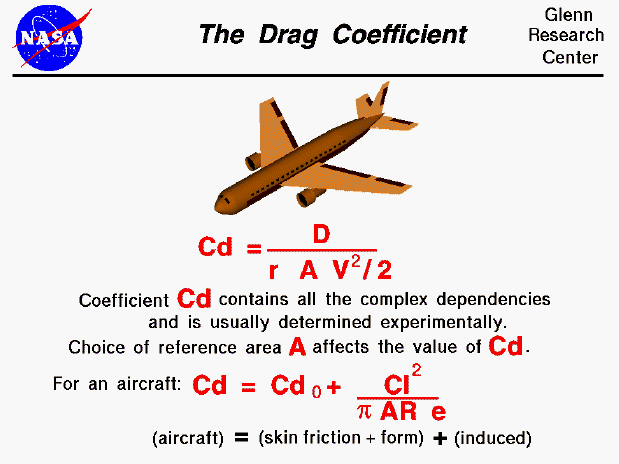
The CD formula in aerodynamics is a mathematical equation used to calculate the drag coefficient of an object moving through a fluid, such as air or water. The formula is: CD = 2 (FD / (ρ v^2 A)), where CD is the drag coefficient, FD is the drag force, ρ is the air density, v is the velocity of the object, and A is the cross-sectional area of the object.
Understanding the Drag Coefficient
The drag coefficient is a dimensionless quantity that represents the aerodynamic drag characteristics of an object. It is used to calculate the drag force experienced by an object moving through a fluid. The drag coefficient depends on the shape and size of the object, as well as the Reynolds number, which is a measure of the turbulence of the fluid flow. Some of the key factors that affect the drag coefficient include:
- Shape: The shape of the object can significantly affect the drag coefficient. For example, a sphere has a lower drag coefficient than a cube.
- Size: The size of the object can also affect the drag coefficient. Larger objects tend to have a higher drag coefficient than smaller objects.
- Surface roughness: The surface roughness of the object can also affect the drag coefficient. A smooth surface can reduce the drag coefficient, while a rough surface can increase it.
Calculating the Drag Force
The drag force is a measure of the aerodynamic drag experienced by an object moving through a fluid. It can be calculated using the drag coefficient and the velocity of the object. The formula for calculating the drag force is: FD = 0.5 ρ v^2 A CD, where FD is the drag force, ρ is the air density, v is the velocity of the object, A is the cross-sectional area of the object, and CD is the drag coefficient. Some of the key factors that affect the drag force include:
- Velocity: The velocity of the object has a significant impact on the drag force. As the velocity increases, the drag force also increases.
- Air density: The air density also affects the drag force. As the air density increases, the drag force also increases.
- Cross-sectional area: The cross-sectional area of the object also affects the drag force. As the cross-sectional area increases, the drag force also increases.
Applications of the CD Formula
The CD formula has a wide range of applications in aerodynamics and engineering. It is used to calculate the aerodynamic drag of objects such as aircraft, cars, and trains. The formula is also used to optimize the aerodynamic performance of these objects, by minimizing the drag coefficient and maximizing the efficiency. Some of the key applications of the CD formula include:
- Aircraft design: The CD formula is used to calculate the aerodynamic drag of aircraft and optimize their aerodynamic performance.
- Car design: The CD formula is used to calculate the aerodynamic drag of cars and optimize their aerodynamic performance.
- Train design: The CD formula is used to calculate the aerodynamic drag of trains and optimize their aerodynamic performance.
Limitations of the CD Formula
The CD formula has several limitations that must be considered when using it to calculate the aerodynamic drag of an object. One of the main limitations is that the formula assumes a laminar flow regime, which may not always be the case in real-world applications. The formula also assumes a steady-state flow, which may not always be the case in unsteady flows. Some of the key limitations of the CD formula include:
- Laminar flow: The CD formula assumes a laminar flow regime, which may not always be the case in real-world applications.
- Steady-state: The CD formula assumes a steady-state flow, which may not always be the case in unsteady flows.
- Turbulence: The CD formula does not account for turbulence, which can significantly affect the aerodynamic drag of an object.
Future Developments in CD Formula Research
Research is ongoing to improve the accuracy and applicability of the CD formula. One area of research is the development of new mathematical models that can account for turbulence and unsteady flows. Another area of research is the use of computational fluid dynamics (CFD) to simulate the aerodynamic flow around objects and calculate the aerodynamic drag. Some of the key areas of research include:
- Turbulence models: Researchers are developing new turbulence models that can account for the turbulent flow regime.
- Unsteady flow models: Researchers are developing new unsteady flow models that can account for the unsteady flow regime.
- CFD simulations: Researchers are using CFD simulations to simulate the aerodynamic flow around objects and calculate the aerodynamic drag.
How is aerodynamic drag measured?
Aerodynamic drag is measured using various techniques, including wind tunnel testing, computational fluid dynamics (CFD), and flight testing. These methods allow researchers to quantify the drag forces acting on an object, such as an aircraft or a vehicle, and to analyze the flow patterns around it. By measuring aerodynamic drag, engineers can optimize the design of objects to reduce drag coefficients and improve their overall performance.
Introduction to Aerodynamic Drag Measurement
Aerodynamic drag measurement is a crucial aspect of aerodynamics research, as it helps to understand the interaction between fluids and solids. To measure aerodynamic drag, researchers use various instruments, such as strain gauges, load cells, and hot wire anemometers. These instruments allow for the measurement of drag forces, lift forces, and flow velocities. Some key points to consider when measuring aerodynamic drag include:
- Scale modeling: Using scale models to simulate real-world conditions and reduce costs.
- Tunnel design: Designing wind tunnels to minimize turbulence and boundary layer effects.
- Sensor calibration: Calibrating sensors to ensure accurate drag force measurements.
- Data acquisition: Collecting and analyzing large amounts of data to understand flow patterns.
- Uncertainty analysis: Quantifying the uncertainty associated with drag measurements.
Wind Tunnel Testing for Aerodynamic Drag Measurement
Wind tunnel testing is a widely used method for measuring aerodynamic drag. Wind tunnels are designed to simulate flow conditions around an object, allowing researchers to measure drag forces and flow velocities. The test section of a wind tunnel is where the object is placed, and flow control systems are used to regulate flow rates and turbulence levels. Some key considerations for wind tunnel testing include:
- Tunnel speed: Controlling the flow velocity to match real-world conditions.
- Model mounting: Securing the test model to minimize vibration and movement.
- Flow control: Regulating flow rates and turbulence levels to simulate real-world conditions.
- Sensor placement: Positioning sensors to measure drag forces and flow velocities accurately.
- Data reduction: Analyzing large amounts of data to extract drag coefficients and flow patterns.
Computational Fluid Dynamics for Aerodynamic Drag Measurement
Computational fluid dynamics (CFD) is a numerical method used to simulate fluid flow and measure aerodynamic drag. CFD software solves the Navier-Stokes equations to predict flow patterns and drag forces. CFD is a cost-effective and time-efficient method for measuring aerodynamic drag, as it eliminates the need for physical prototypes. Some key aspects of CFD for aerodynamic drag measurement include:
- Grid generation: Creating a computational grid to discretize the flow domain.
- Boundary conditions: Defining boundary conditions to simulate real-world flow conditions.
- Turbulence modeling: Selecting a turbulence model to capture turbulent flow effects.
- Solver settings: Configuring solver settings to ensure accurate and efficient simulations.
- Validation: Validating CFD results against experimental data to ensure accuracy.
Flight Testing for Aerodynamic Drag Measurement
Flight testing is a method used to measure aerodynamic drag in real-world flight conditions. Flight test instruments are used to measure drag forces, lift forces, and flow velocities during flight. Flight testing provides accurate and reliable data, but it can be expensive and time-consuming. Some key considerations for flight testing include:
- Test planning: Planning flight test procedures to ensure safe and efficient data collection.
- Instrumentation: Selecting flight test instruments to measure drag forces and flow velocities.
- Data acquisition: Collecting and analyzing large amounts of data to understand flow patterns.
- Weather conditions: Considering weather conditions to ensure safe and valid testing.
- Pilot training: Training pilots to conduct flight tests safely and efficiently.
Applications of Aerodynamic Drag Measurement
Aerodynamic drag measurement has various practical applications, including aircraft design, vehicle design, and wind turbine optimization. By measuring aerodynamic drag, engineers can optimize the design of objects to reduce drag coefficients and improve their overall performance. Some key applications of aerodynamic drag measurement include:
- Aircraft design: Optimizing aircraft shape to reduce drag and improve fuel efficiency.
- Vehicle design: Reducing drag to improve fuel efficiency and reduce emissions.
- Wind turbine optimization: Optimizing wind turbine blades to increase energy production.
- Sports equipment design: Reducing drag to improve performance in sports such as cycling and golf.
- Building design: Reducing wind loads to improve structural integrity and reduce energy consumption.
What is the formula for the drag coefficient NASA?
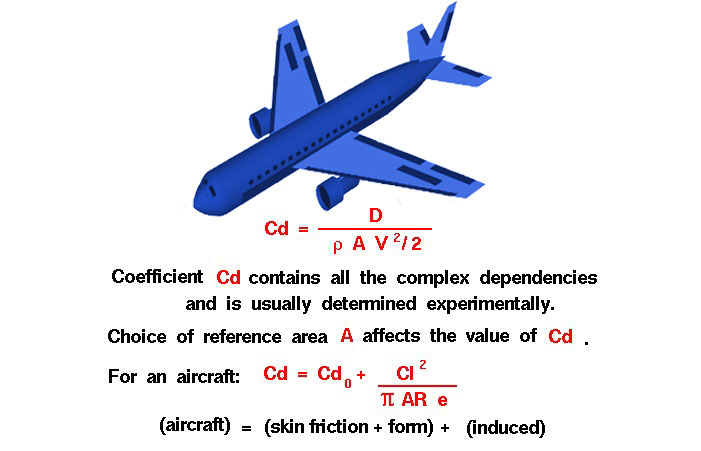
The formula for the drag coefficient NASA is Cd = (2 Fd) / (ρ v^2 A), where Cd is the drag coefficient, Fd is the drag force, ρ is the air density, v is the velocity of the object, and A is the cross-sectional area of the object. This formula is widely used in the field of aerodynamics to calculate the drag coefficient of an object.
Introduction to Drag Coefficient
The drag coefficient is a dimensionless quantity that represents the amount of drag an object experiences as it moves through a fluid, such as air or water. The drag coefficient depends on the shape and size of the object, as well as the velocity and density of the fluid. The formula for the drag coefficient is used to calculate the drag force on an object, which is an important factor in the design of aircraft, spacecraft, and other vehicles.
- The drag coefficient is an important factor in the design of vehicles, as it affects their fuel efficiency and performance.
- The drag coefficient can be influenced by the shape and size of the object, as well as the velocity and density of the fluid.
- The formula for the drag coefficient is used in a variety of fields, including aerodynamics, hydrodynamics, and mechanical engineering.
Factors Affecting Drag Coefficient
There are several factors that can affect the drag coefficient of an object, including its shape, size, and velocity. The shape of an object can significantly affect its drag coefficient, with streamlined shapes experiencing less drag than blunt shapes. The size of an object can also affect its drag coefficient, with larger objects experiencing more drag than smaller objects.
- The shape of an object can significantly affect its drag coefficient, with streamlined shapes experiencing less drag than blunt shapes.
- The size of an object can also affect its drag coefficient, with larger objects experiencing more drag than smaller objects.
- The velocity of an object can also affect its drag coefficient, with faster objects experiencing more drag than slower objects.
Applications of Drag Coefficient
The drag coefficient has a wide range of applications in various fields, including aeronautics, astronautics, and mechanical engineering. In aeronautics, the drag coefficient is used to calculate the drag force on an aircraft, which is an important factor in its design and performance. In astronautics, the drag coefficient is used to calculate the drag force on a spacecraft, which is an important factor in its design and trajectory.
- The drag coefficient is used in aeronautics to calculate the drag force on an aircraft.
- The drag coefficient is used in astronautics to calculate the drag force on a spacecraft.
- The drag coefficient is also used in mechanical engineering to calculate the drag force on a variety of objects, including cars and bicycles.
Measurement of Drag Coefficient
The drag coefficient can be measured using a variety of techniques, including wind tunnel testing and computational fluid dynamics. Wind tunnel testing involves measuring the drag force on an object as it moves through a wind tunnel, while computational fluid dynamics involves using computer simulations to calculate the drag force on an object.
- Wind tunnel testing is a common method for measuring the drag coefficient of an object.
- Computational fluid dynamics is also used to measure the drag coefficient of an object.
- Experimental methods, such as force balance and pressure sensors, can also be used to measure the drag coefficient of an object.
Calculation of Drag Coefficient
The drag coefficient can be calculated using a variety of formulas, including the NASA formula and the Prandtl formula. The NASA formula is a semi-empirical formula that is widely used in the field of aerodynamics, while the Prandtl formula is a theoretical formula that is based on the boundary layer theory.
- The NASA formula is a semi-empirical formula that is widely used in the field of aerodynamics.
- The Prandtl formula is a theoretical formula that is based on the boundary layer theory.
- Computational fluid dynamics can also be used to calculate the drag coefficient of an object.
Frequently Asked Questions (FAQs)
Aerodynamic Drag Equation and Calculator: What is the purpose of the drag equation in aerodynamics?
The aerodynamic drag equation is a fundamental concept in the field of aerodynamics, and its purpose is to calculate the drag force that acts on an object as it moves through a fluid, such as air or water. The equation takes into account several factors, including the density of the fluid, the velocity of the object, and the shape and size of the object. By using the drag equation, engineers and researchers can predict the amount of drag that an object will experience, which is crucial in the design and optimization of vehicles, aircraft, and other objects that move through fluids. The drag coefficient, which is a key component of the drag equation, is a measure of the object's aerodynamic efficiency, and it can be used to compare the drag characteristics of different objects.
How does the Aerodynamic Drag Equation and Calculator work?
The Aerodynamic Drag Equation and Calculator is a tool that uses the drag equation to calculate the drag force that acts on an object. The calculator typically requires the user to input several parameters, including the density of the fluid, the velocity of the object, and the drag coefficient of the object. The calculator then uses these inputs to calculate the drag force, which is typically expressed in units of newtons or pounds. The calculator may also provide additional information, such as the power required to overcome the drag force, or the energy lost due to drag. The calculator is often used in conjunction with computer simulations and wind tunnel testing to validate the results and optimize the design of the object. By using the calculator, engineers and researchers can quickly and easily estimate the drag characteristics of an object, and make informed decisions about its design and optimization.
What are the key factors that affect the Aerodynamic Drag Equation and Calculator?
There are several key factors that affect the Aerodynamic Drag Equation and Calculator, including the density of the fluid, the velocity of the object, and the drag coefficient of the object. The density of the fluid is a critical factor, as it affects the amount of drag force that is generated. For example, an object moving through air will experience less drag than an object moving through water, due to the difference in density between the two fluids. The velocity of the object is also important, as it affects the amount of kinetic energy that is transferred to the fluid, and therefore the amount of drag force that is generated. The drag coefficient is a measure of the object's aerodynamic efficiency, and it can be affected by the shape and size of the object, as well as the surface roughness and cleanup of the object. Other factors, such as turbulence and boundary layers, can also affect the drag equation and calculator.
How can the Aerodynamic Drag Equation and Calculator be applied in real-world scenarios?
The Aerodynamic Drag Equation and Calculator can be applied in a wide range of real-world scenarios, including the design and optimization of aircraft, automobiles, and wind turbines. For example, aircraft designers can use the calculator to estimate the drag force that will act on an aircraft during flight, and optimize the shape and size of the aircraft to minimize drag and maximize fuel efficiency. Automobile manufacturers can use the calculator to estimate the drag force that will act on a vehicle during highway driving, and optimize the aerodynamic design of the vehicle to improve fuel efficiency and reduce emissions. Wind turbine designers can use the calculator to estimate the drag force that will act on the turbine blades, and optimize the shape and size of the blades to maximize energy production. The calculator can also be used in research and development applications, such as wind tunnel testing and computer simulations, to validate the results and optimize the design of the object. By using the Aerodynamic Drag Equation and Calculator, engineers and researchers can make informed decisions about the design and optimization of objects that move through fluids, and improve their aerodynamic efficiency and performance.
Deja una respuesta
Entradas Relacionadas