
Beam on Elastic Foundation Spreadsheet Calculator Spreadsheet Calculator

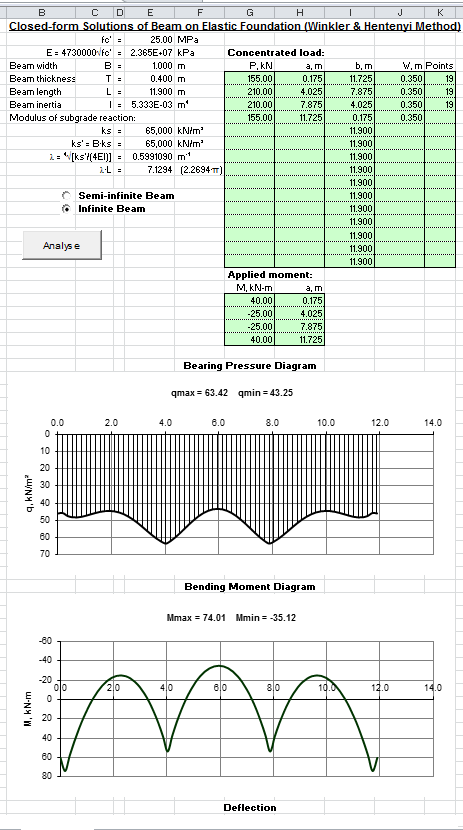
The Beam on Elastic Foundation Spreadsheet Calculator is a crucial tool for engineers and designers working with beam structures. It provides a comprehensive and efficient way to analyze and calculate the behavior of beams on elastic foundations under various loads. This calculator allows users to input parameters such as beam length, foundation modulus, and loading conditions, and then generates accurate results, including bending moments, shear forces, and deflections. By utilizing this calculator, users can optimize their designs and ensure the structural integrity of their beam systems. It simplifies complex calculations and saves time.
- Beam on Elastic Foundation Spreadsheet Calculator: A Comprehensive Tool for Engineers
-
Understanding the Beam on Elastic Foundation Spreadsheet Calculator
- Introduction to Beam on Elastic Foundation Theory
- Calculating Deflection and Bending Moment using the Spreadsheet Calculator
- Understanding the Importance of Elastic Modulus in Beam Design
- Applying Load Conditions to the Beam on Elastic Foundation Spreadsheet Calculator
- Validating the Results of the Beam on Elastic Foundation Spreadsheet Calculator
-
Frequently Asked Questions (FAQs)
- What is the purpose of the Beam on Elastic Foundation Spreadsheet Calculator?
- How does the Beam on Elastic Foundation Spreadsheet Calculator handle different types of loads and boundary conditions?
- Can the Beam on Elastic Foundation Spreadsheet Calculator be used for both static and dynamic analysis?
- Is the Beam on Elastic Foundation Spreadsheet Calculator suitable for use in academic and research settings?”
Beam on Elastic Foundation Spreadsheet Calculator: A Comprehensive Tool for Engineers
The Beam on Elastic Foundation Spreadsheet Calculator is a powerful tool used by engineers to analyze and design beams on elastic foundations. This calculator is a spreadsheet-based program that allows users to input various parameters such as beam length, foundation stiffness, and load conditions to calculate the deflection, bending moment, and shear force of the beam. The calculator is widely used in the field of civil engineering, particularly in the design of foundations, pavements, and other structural elements.
Introduction to Beam on Elastic Foundation Theory
The theory of beams on elastic foundations is based on the assumption that the foundation is a continuous, elastic medium that can deform under the load applied to the beam. The beam is considered to be a continuous, straight member that is supported by the elastic foundation. The foundation is modeled as a series of springs that can deform under the load, and the beam is analyzed using the finite element method. The Beam on Elastic Foundation Spreadsheet Calculator uses this theory to calculate the deflection, bending moment, and shear force of the beam.
Input Parameters for the Calculator
The Beam on Elastic Foundation Spreadsheet Calculator requires several input parameters to calculate the behavior of the beam. These parameters include:
| Parameter | Description |
|---|---|
| Beam Length | The length of the beam |
| Foundation Stiffness | The stiffness of the elastic foundation |
| Load Conditions | The type and magnitude of the load applied to the beam |
These parameters are used to calculate the beam's behavior under various load conditions.
Calculation of Deflection, Bending Moment, and Shear Force
The Beam on Elastic Foundation Spreadsheet Calculator uses the input parameters to calculate the deflection, bending moment, and shear force of the beam. The calculator uses the finite element method to discretize the beam into smaller elements and calculate the behavior of each element. The results are then combined to obtain the overall behavior of the beam. The calculator provides a detailed output of the deflection, bending moment, and shear force along the length of the beam.
Applications of the Beam on Elastic Foundation Spreadsheet Calculator
The Beam on Elastic Foundation Spreadsheet Calculator has several applications in the field of civil engineering. It can be used to design foundations, pavements, and other structural elements that are supported by an elastic foundation. The calculator can also be used to analyze the behavior of beams under various load conditions, including uniformly distributed loads, point loads, and moment loads. The calculator is a valuable tool for engineers who need to design and analyze beams on elastic foundations.
Advantages of the Beam on Elastic Foundation Spreadsheet Calculator
The Beam on Elastic Foundation Spreadsheet Calculator has several advantages over other methods of analysis. It is a fast and efficient method of analysis that can be used to calculate the behavior of complex beam systems. The calculator is also easy to use and requires minimal input from the user. The calculator provides a detailed output of the beam's behavior, including the deflection, bending moment, and shear force along the length of the beam. The calculator is a powerful tool that can be used to design and analyze beams on elastic foundations, and it is widely used in the field of civil engineering. The calculator uses strong and reliable algorithms to calculate the behavior of the beam, and it provides accurate results that can be used to design and analyze beams on elastic foundations.
Understanding the Beam on Elastic Foundation Spreadsheet Calculator
The Beam on Elastic Foundation Spreadsheet Calculator is a powerful tool used to analyze and design beams supported by an elastic foundation. This calculator is widely used in the field of civil engineering and structural analysis to determine the deflection, bending moment, and shear force of a beam under various loading conditions. The calculator takes into account the beam's length, width, and thickness, as well as the elastic modulus of the foundation and the load applied to the beam. By using this calculator, engineers can quickly and accurately determine the stress and strain on the beam, allowing them to optimize their design and ensure the stability and safety of the structure.
Introduction to Beam on Elastic Foundation Theory
The Beam on Elastic Foundation theory is based on the concept of a beam supported by a continuous elastic foundation, which can be thought of as a series of springs that provide upward and downward reactions to the beam. This theory is used to analyze the behavior of beams under various loading conditions, including uniformly distributed loads, point loads, and moment loads. The theory takes into account the flexural rigidity of the beam, as well as the elastic properties of the foundation, to determine the deflection and rotation of the beam. By understanding the Beam on Elastic Foundation theory, engineers can design and analyze beams that are supported by a variety of foundations, including soil, concrete, and steel.
Calculating Deflection and Bending Moment using the Spreadsheet Calculator
The Beam on Elastic Foundation Spreadsheet Calculator can be used to calculate the deflection and bending moment of a beam under various loading conditions. The calculator uses the beam's length, width, and thickness, as well as the elastic modulus of the foundation and the load applied to the beam, to determine the maximum deflection and bending moment. The calculator also takes into account the boundary conditions of the beam, including simply supported, fixed, and free ends. By using the calculator, engineers can quickly and accurately determine the deflection and bending moment of the beam, allowing them to optimize their design and ensure the stability and safety of the structure. The calculator also provides a graphical representation of the deflection and bending moment along the length of the beam, allowing engineers to visualize the behavior of the beam.
Understanding the Importance of Elastic Modulus in Beam Design
The elastic modulus of the foundation is a critical parameter in the design of beams supported by an elastic foundation. The elastic modulus represents the stiffness of the foundation, and it plays a significant role in determining the deflection and bending moment of the beam. A higher elastic modulus indicates a stiffer foundation, which can result in a smaller deflection and bending moment. On the other hand, a lower elastic modulus indicates a softer foundation, which can result in a larger deflection and bending moment. By understanding the importance of elastic modulus in beam design, engineers can select the appropriate foundation material and design parameters to ensure the stability and safety of the structure. The elastic modulus can be determined through experimental testing or numerical analysis, and it is typically represented by the symbol E.
Applying Load Conditions to the Beam on Elastic Foundation Spreadsheet Calculator
The Beam on Elastic Foundation Spreadsheet Calculator can be used to apply various load conditions to the beam, including uniformly distributed loads, point loads, and moment loads. The calculator allows engineers to specify the load magnitude, load location, and load direction, and it calculates the resulting deflection, bending moment, and shear force. The calculator also takes into account the load combination, allowing engineers to analyze the behavior of the beam under multiple loads. By applying different load conditions to the calculator, engineers can determine the most critical load case and optimize their design to ensure the stability and safety of the structure. The calculator also provides a summary of results, including the maximum deflection, bending moment, and shear force, allowing engineers to quickly and easily compare different load conditions.
Validating the Results of the Beam on Elastic Foundation Spreadsheet Calculator
The results of the Beam on Elastic Foundation Spreadsheet Calculator can be validated through numerical analysis or experimental testing. The calculator provides a detailed output of the deflection, bending moment, and shear force along the length of the beam, allowing engineers to compare the results with theoretical solutions or experimental data. By validating the results of the calculator, engineers can ensure the accuracy and reliability of their design, and they can optimize their design parameters to achieve the best possible performance. The calculator also provides a sensitivity analysis, allowing engineers to determine the effect of variations in the input parameters on the output results. This allows engineers to refine their design and ensure that it is robust and reliable.
Frequently Asked Questions (FAQs)
What is the purpose of the Beam on Elastic Foundation Spreadsheet Calculator?
The Beam on Elastic Foundation Spreadsheet Calculator is a powerful tool designed to simplify the process of calculating beam deflections and stresses! in beams supported by an elastic foundation. This type of foundation is commonly used in civil engineering projects, such as highways, bridges, and buildings, where the soil or other underlying material can provide some degree of flexural support to the beam. The calculator uses advanced mathematical models to simulate the behavior of the beam under various loads and boundary conditions, allowing engineers to quickly and accurately determine the optimal design parameters for their projects. By using this calculator, engineers can save time and effort that would otherwise be spent on manual calculations or complex finite element analysis, and instead focus on optimizing their designs for maximum safety and efficiency.
How does the Beam on Elastic Foundation Spreadsheet Calculator handle different types of loads and boundary conditions?
The Beam on Elastic Foundation Spreadsheet Calculator is capable of handling a wide range of loads and boundary conditions, making it a versatile tool for engineers working on various types of projects. The calculator can simulate point loads, uniformly distributed loads, and linearly varying loads, as well as moment loads and torque loads. Additionally, the calculator can account for different boundary conditions, such as simply supported, clamped, or free ends, and can even handle non-uniform foundation modulus and density. The calculator uses advanced numerical methods, such as the finite difference method or the finite element method, to solve the governing equations of the beam-foundation system, ensuring that the results are accurate and reliable. By providing a user-friendly interface for inputting load and boundary condition data, the calculator makes it easy for engineers to model and analyze complex beam systems, even those with nonlinear behavior.
Can the Beam on Elastic Foundation Spreadsheet Calculator be used for both static and dynamic analysis?
Yes, the Beam on Elastic Foundation Spreadsheet Calculator can be used for both static and dynamic analysis of beams on elastic foundations. The calculator includes advanced features that allow engineers to model and analyze the dynamic behavior of the beam-foundation system, including natural frequencies, mode shapes, and time-history responses. The calculator can also account for damping and nonlinear effects, making it suitable for seismic analysis and other dynamic loading scenarios. For static analysis, the calculator can be used to determine the deflection, stress, and strain distributions in the beam under various loads and boundary conditions. The calculator's ability to handle both static and dynamic analysis makes it a valuable tool for engineers working on a wide range of projects, from building design to bridge construction.
Is the Beam on Elastic Foundation Spreadsheet Calculator suitable for use in academic and research settings?”
The Beam on Elastic Foundation Spreadsheet Calculator is highly suitable for use in academic and research settings, where accurate and reliable calculations are crucial. The calculator's advanced mathematical models and numerical methods make it an excellent tool for teaching and researching various topics in civil engineering, such as beam theory, foundation engineering, and structural dynamics. The calculator's user-friendly interface and extensive documentation also make it easy for students and researchers to learn and use the calculator, even those with limited experience in structural analysis. Additionally, the calculator's ability to handle complex and nonlinear problems makes it a valuable resource for researchers working on cutting-edge topics in civil engineering, such as smart materials and structural health monitoring. By using the Beam on Elastic Foundation Spreadsheet Calculator, academics and researchers can focus on developing new theories and methods, rather than spending time and effort on manual calculations or complex programming.
Deja una respuesta
Entradas Relacionadas