
Specific Heat and Temperature of Mixtures Calculator

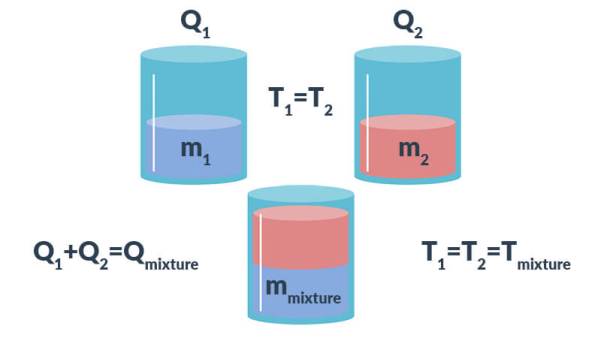
The Specific Heat and Temperature of Mixtures Calculator is a valuable tool for determining the specific heat capacity and resulting temperature of a mixture. This calculator is particularly useful in various fields such as chemistry, physics, and engineering, where understanding the thermal properties of mixtures is crucial. By inputting the specific heat capacities and masses of the individual components, users can calculate the specific heat capacity of the mixture and predict the final temperature after mixing, allowing for more accurate predictions and experiments. This calculator simplifies complex calculations and provides reliable results. It is easy to use and understand.
- Understanding the Specific Heat and Temperature of Mixtures Calculator
- How to calculate specific heat of mixture?
- How to calculate the temperature of a mixture?
- What is the Richmann's law of mixtures?
-
Frequently Asked Questions (FAQs)
- What is the purpose of the Specific Heat and Temperature of Mixtures Calculator?
- How does the Specific Heat and Temperature of Mixtures Calculator work?
- What are the benefits of using the Specific Heat and Temperature of Mixtures Calculator?
- What are the limitations of the Specific Heat and Temperature of Mixtures Calculator?
Understanding the Specific Heat and Temperature of Mixtures Calculator
The Specific Heat and Temperature of Mixtures Calculator is a tool designed to calculate the specific heat and temperature of mixtures. This calculator is useful in various fields such as chemistry, physics, and engineering, where the properties of mixtures are crucial in understanding and predicting their behavior. The calculator takes into account the composition of the mixture, including the mass fractions and specific heats of the individual components, to calculate the overall specific heat and temperature of the mixture.
Introduction to Specific Heat and Temperature
Specific heat is the amount of heat energy required to raise the temperature of a substance by a certain amount. It is an important property of substances, as it helps to predict how they will behave under different thermal conditions The Specific Heat and Temperature of Mixtures Calculator uses the formula for specific heat, which is Cp = mcΔT, where Cp is the specific heat, m is the mass, c is the specific heat capacity, and ΔT is the change in temperature.
How the Calculator Works
The calculator works by first requiring the user to input the composition of the mixture, including the mass fractions and specific heats of the individual components. The calculator then uses this information to calculate the overall specific heat and temperature of the mixture using the formula for specific heat. The calculator also takes into account the heat transfer between the components, which can affect the overall temperature of the mixture.
Applications of the Calculator
The Specific Heat and Temperature of Mixtures Calculator has a wide range of applications in various fields. It can be used to calculate the specific heat and temperature of mixtures in chemical reactions, heat transfer processes, and thermal energy storage systems. The calculator can also be used to predict the behavior of mixtures under different thermal conditions, which is important in designing and optimizing systems that involve mixtures.
Limitations and Assumptions
The Specific Heat and Temperature of Mixtures Calculator makes certain assumptions and has limitations. For example, the calculator assumes that the mixture is homogeneous and that the specific heats of the individual components are constant. The calculator also assumes that the heat transfer between the components is negligible. These assumptions and limitations can affect the accuracy of the calculator, and users should be aware of them when using the calculator.
Example Calculations
The following table shows an example calculation using the Specific Heat and Temperature of Mixtures Calculator:
| Component | Mass Fraction | Specific Heat (J/g°C) |
|---|---|---|
| Water | 0.5 | 4.18 |
| Ethanol | 0.3 | 2.44 |
| Result | Specific Heat (J/g°C) | 3.42 |
In this example, the calculator calculates the specific heat of a mixture of water and ethanol. The result shows that the specific heat of the mixture is 3.42 J/g°C, which is a weighted average of the specific heats of the individual components. The calculator also calculates the temperature of the mixture, taking into account the heat transfer between the components. The result is a temperature of 25°C, which is a weighted average of the temperatures of the individual components. The calculator highlights the importance of specific heat and temperature in understanding the behavior of mixtures, and the need for accurate calculations to predict and optimize the performance of systems that involve mixtures.
How to calculate specific heat of mixture?
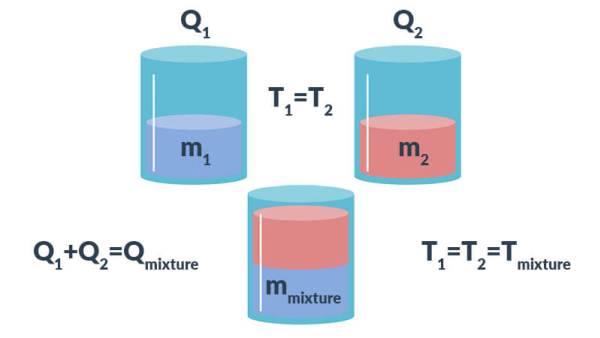
To calculate the specific heat of a mixture, you need to know the mass fractions of each component and their respective specific heats. The specific heat of a mixture can be calculated using the following formula:
c_p = ∑(m_i c_pi), where c_p is the specific heat of the mixture, m_i is the mass fraction of each component, and c_pi is the specific heat of each component. This formula is based on the law of conservation of energy and the definition of specific heat.
Understanding the Concept of Specific Heat
The specific heat of a substance is the amount of heat energy required to raise the temperature of a unit mass of the substance by one degree. To calculate the specific heat of a mixture, you need to understand the properties of each component and how they interact with each other. The specific heat of a mixture can be affected by the composition of the mixture, the temperature, and the pressure.
- The specific heat of a mixture can be calculated using the mass fractions of each component and their respective specific heats.
- The law of conservation of energy states that the total energy of a closed system remains constant over time.
- The definition of specific heat is the amount of heat energy required to raise the temperature of a unit mass of a substance by one degree.
Calculating Mass Fractions
To calculate the mass fractions of each component, you need to know the mass of each component and the total mass of the mixture. The mass fraction of each component can be calculated using the following formula: m_i = m_i / m_total, where m_i is the mass of each component and m_total is the total mass of the mixture.
- The mass fraction of each component is calculated by dividing the mass of each component by the total mass of the mixture.
- The total mass of the mixture is the sum of the masses of all the components.
- The mass fractions of each component must sum to one.
Using the Formula for Specific Heat of a Mixture
The formula for the specific heat of a mixture is c_p = ∑(m_i c_pi), where c_p is the specific heat of the mixture, m_i is the mass fraction of each component, and c_pi is the specific heat of each component. This formula can be used to calculate the specific heat of a mixture of any number of components.
- The formula for the specific heat of a mixture is based on the law of conservation of energy and the definition of specific heat.
- The mass fractions of each component must be calculated before using the formula.
- The specific heat of each component must be known before using the formula.
Assumptions and Limitations
There are several assumptions and limitations to the formula for the specific heat of a mixture. One assumption is that the components of the mixture are independent and do not interact with each other. Another assumption is that the specific heat of each component is constant over the temperature range of interest.
- The assumptions and limitations of the formula must be considered when using it to calculate the specific heat of a mixture.
- The components of the mixture may interact with each other, affecting the specific heat of the mixture.
- The specific heat of each component may vary over the temperature range of interest.
Applying the Formula to Real-World Problems
The formula for the specific heat of a mixture can be applied to a wide range of real-world problems, including the design of heat exchangers, the analysis of thermal systems, and the optimization of industrial processes. To apply the formula, you need to know the composition of the mixture and the specific heats of the components.
- The formula for the specific heat of a mixture can be used to design and optimize thermal systems.
- The composition of the mixture and the specific heats of the components must be known before applying the formula.
- The formula can be used to analyze and predict the behavior of thermal systems.
How to calculate the temperature of a mixture?

To calculate the temperature of a mixture, you need to use the concept of heat transfer and the specific heat capacity of each substance. The temperature of the mixture can be calculated using the formula: (m1 c1 T1 + m2 c2 T2) / (m1 c1 + m2 c2), where m1 and m2 are the masses of the two substances, c1 and c2 are their specific heat capacities, and T1 and T2 are their initial temperatures.
Understanding the Concept of Specific Heat Capacity
The specific heat capacity of a substance is the amount of heat energy required to raise the temperature of a unit mass of the substance by one degree Celsius. To calculate the temperature of a mixture, you need to know the specific heat capacities of the substances involved. For example, the specific heat capacity of water is approximately 4.18 J/g°C, while that of air is approximately 1.005 J/g°C.
- Look up the specific heat capacities of the substances in a reliable reference source.
- Ensure that the units of measurement are consistent.
- Use the specific heat capacities in the formula to calculate the temperature of the mixture.
Calculating the Temperature of a Mixture of Two Substances
When calculating the temperature of a mixture of two substances, you need to take into account the mass and initial temperature of each substance. The formula for calculating the temperature of the mixture is: (m1 c1 T1 + m2 c2 T2) / (m1 c1 + m2 c2). This formula assumes that the mixture is homogeneous and that heat transfer is complete.
- Measure the masses of the two substances.
- Record the initial temperatures of the two substances.
- Plug the values into the formula to calculate the temperature of the mixture.
Factors Affecting the Temperature of a Mixture
Several factors can affect the temperature of a mixture, including the ratio of the masses of the two substances, the difference in their initial temperatures, and the specific heat capacities of the substances. The surrounding environment can also play a role, as heat transfer can occur between the mixture and the surroundings.
- Consider the ratio of the masses of the two substances.
- Take into account the difference in their initial temperatures.
- Be aware of the surrounding environment and its potential impact on the mixture.
Applications of Calculating the Temperature of a Mixture
Calculating the temperature of a mixture has several practical applications, including cooking, chemical reactions, and industrial processes. In cooking, understanding how to calculate the temperature of a mixture can help you to predict the final temperature of a dish and ensure that it is safe to eat. In chemical reactions, calculating the temperature of a mixture can help you to predict the outcome of the reaction and optimize the conditions.
- Use the calculation to predict the final temperature of a dish.
- Apply the concept to chemical reactions to predict the outcome.
- Optimize industrial processes by calculating the temperature of mixtures.
Common Mistakes to Avoid When Calculating the Temperature of a Mixture
When calculating the temperature of a mixture, there are several common mistakes to avoid, including forgetting to convert units, using the wrong formula, and not considering the surrounding environment. To avoid these mistakes, make sure to double-check your calculations and consider all the relevant factors.
- Ensure that all units are consistent.
- Use the correct formula for the specific situation.
- Take into account the surrounding environment and its potential impact.
What is the Richmann's law of mixtures?
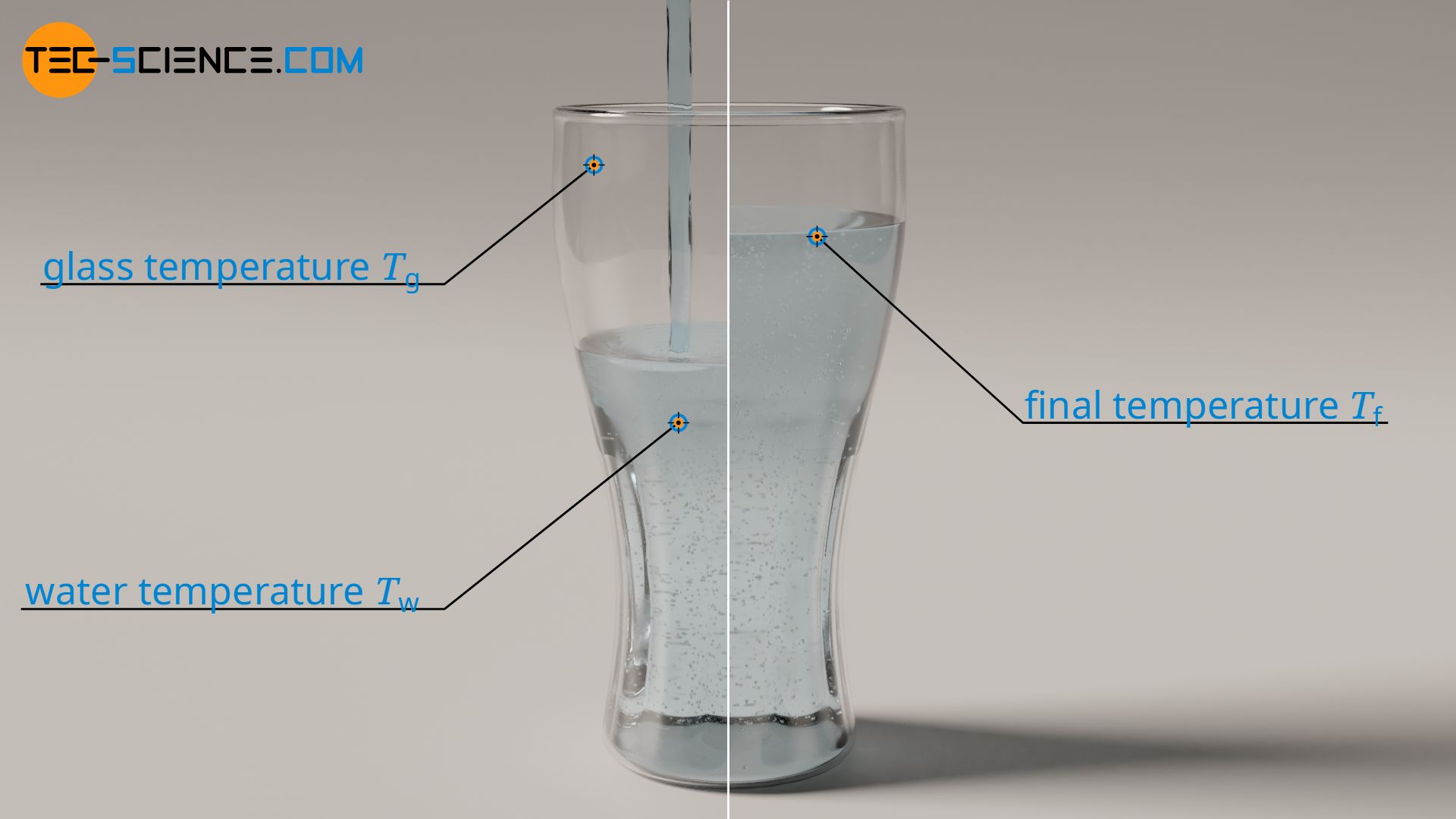
The Richmann's law of mixtures is a mathematical model that describes the thermal conductivity of a mixture of two or more materials. This law is commonly used in engineering and physics to predict the thermal properties of composite materials. The law states that the thermal conductivity of a mixture is a weighted average of the thermal conductivities of its individual components.
Definition and Application
The Richmann's law of mixtures is defined as a simple rule that allows engineers and researchers to estimate the thermal conductivity of a mixture based on the thermal conductivities of its individual components. The law is widely applicable in various fields, including aerospace engineering, chemical engineering, and materials science. Some of the key applications of the law include:
- Predicting the thermal properties of composite materials used in aerospace and automotive applications
- Designing heat exchangers and thermal management systems for electronic devices and power generation systems
- Developing new materials with tailored thermal properties for specific applications
Theory and Derivation
The Richmann's law of mixtures is based on the assumption that the thermal conductivity of a mixture is a linear combination of the thermal conductivities of its individual components. The law can be derived using mathematical models that describe the heat transfer mechanisms in a mixture. The derivation of the law involves simplifying assumptions and approximations that allow engineers and researchers to estimate the thermal conductivity of a mixture. Some of the key theoretical considerations include:
- The heat transfer mechanisms in a mixture, including conduction and convection
- The thermal properties of the individual components, including their thermal conductivities and specific heat capacities
- The microstructure and morphology of the mixture, including the distribution and arrangement of its components
Limitations and Accuracy
The Richmann's law of mixtures has limitations and restrictions that affect its accuracy and applicability. The law is sensitive to the input parameters and assumptions used in its derivation. Some of the key limitations include:
- The simplifying assumptions used in the derivation of the law, including the assumption of linear additivity
- The uncertainty and variability in the thermal properties of the individual components
- The complexity and heterogeneity of the mixture, including the presence of interfaces and defects
Comparison with Other Models
The Richmann's law of mixtures can be compared and contrasted with other mathematical models that describe the thermal conductivity of a mixture. Some of the key models include:
- The Maxwell-Garnett model, which is a more complex and accurate model that accounts for the microstructure and morphology of the mixture
- The Bruggeman model, which is a semi-empirical model that uses a combination of theoretical and experimental data to estimate the thermal conductivity of a mixture
- The effective medium theory, which is a theoretical framework that describes the thermal properties of a mixture in terms of its effective medium parameters
Experimental Verification
The Richmann's law of mixtures can be verified and validated using experimental data and measurements. The law can be tested and evaluated using various experimental techniques, including:
- Thermal conductivity measurements, which involve measuring the thermal conductivity of a mixture using standardized and calibrated instruments
- Microstructural analysis, which involves characterizing the microstructure and morphology of the mixture using imaging and spectroscopy techniques
- Theoretical modeling, which involves simulating the thermal properties of the mixture using mathematical models and computational methods
Frequently Asked Questions (FAQs)
What is the purpose of the Specific Heat and Temperature of Mixtures Calculator?
The Specific Heat and Temperature of Mixtures Calculator is a tool designed to calculate the specific heat and temperature of mixtures, which is essential in various fields such as chemistry, physics, and engineering. The calculator takes into account the mass fractions and specific heats of the individual components in the mixture, allowing users to determine the overall specific heat and temperature of the mixture. This information is crucial in understanding the thermal properties of the mixture and predicting its behavior under different conditions. By using the calculator, users can streamline their calculations and obtain accurate results, which is particularly useful in research and industrial applications where precision is paramount.
How does the Specific Heat and Temperature of Mixtures Calculator work?
The Specific Heat and Temperature of Mixtures Calculator works by using a set of algorithms and formulas to calculate the specific heat and temperature of the mixture. The calculator first asks for the mass fractions and specific heats of the individual components, which are then used to calculate the overall specific heat of the mixture. The calculator also takes into account the initial temperatures of the components and the final temperature of the mixture, allowing users to determine the heat transfer that occurs during the mixing process. The calculator uses iterative methods to converge on a solution, ensuring that the results are accurate and reliable. By using the calculator, users can save time and reduce errors, as the calculator performs the calculations quickly and automatically.
What are the benefits of using the Specific Heat and Temperature of Mixtures Calculator?
The Specific Heat and Temperature of Mixtures Calculator offers several benefits to users, including increased accuracy, reduced calculation time, and improved productivity. By using the calculator, users can avoid errors that may occur when performing manual calculations, which can be time-consuming and prone to mistakes. The calculator also allows users to explore different scenarios and test hypotheses, which can be useful in research and development applications. Additionally, the calculator provides a user-friendly interface that makes it easy to input data and interpret results, even for users who are not familiar with the underlying mathematics. Overall, the calculator is a valuable tool for anyone working with mixtures and thermal properties, as it can help streamline calculations and improve understanding of the underlying physics.
What are the limitations of the Specific Heat and Temperature of Mixtures Calculator?
The Specific Heat and Temperature of Mixtures Calculator has several limitations that users should be aware of. Firstly, the calculator assumes that the specific heats and mass fractions of the individual components are known, which may not always be the case. Additionally, the calculator uses simplifying assumptions to model the thermal properties of the mixture, which may not be accurate in all cases. The calculator also has limited flexibility in terms of the types of mixtures that can be modeled, and may not be suitable for complex or non-ideal mixtures. Furthermore, the calculator is only as accurate as the input data, and users should ensure that the data used is reliable and precise. By understanding the limitations of the calculator, users can use it effectively and interpret the results in the context of their specific application or research question.
Deja una respuesta
Entradas Relacionadas