
Area Moment of Inertia Section Properties: Triangle Edge Calculator

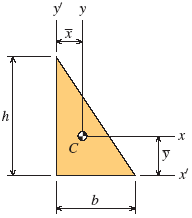
The Area Moment of Inertia is a crucial section property in engineering, describing an object's resistance to changes in its rotation. For triangular sections, calculating this property can be complex. The Triangle Edge Calculator simplifies this process, providing accurate results for various triangle configurations. By inputting key dimensions, users can effortlessly determine the Area Moment of Inertia, enabling efficient design and analysis of structures. This calculator is an essential tool for engineers, saving time and reducing errors in calculations. It offers a straightforward solution for triangle section properties calculation, making it a valuable resource.
- Understanding Area Moment of Inertia Section Properties: Triangle Edge Calculator
-
Understanding the Triangle Edge Calculator for Area Moment of Inertia Section Properties
- Introduction to Moment of Inertia and Its Importance in Engineering
- Key Features and Benefits of the Triangle Edge Calculator
- Applications of the Triangle Edge Calculator in Real-World Scenarios
- Calculating Moment of Inertia Using the Triangle Edge Calculator
- Common Challenges and Limitations of the Triangle Edge Calculator
-
Frequently Asked Questions (FAQs)
- What is the Area Moment of Inertia and how is it calculated for a Triangle Edge?
- How does the Triangle Edge Calculator work and what are its limitations?
- What are the applications of the Area Moment of Inertia in engineering and physics?
- How can I use the Triangle Edge Calculator to optimize the design of a structural element?
Understanding Area Moment of Inertia Section Properties: Triangle Edge Calculator
The Area Moment of Inertia Section Properties: Triangle Edge Calculator is a tool used to calculate the moment of inertia and other section properties of a triangle. The moment of inertia is a measure of an object's resistance to changes in its rotation, and it is an important factor in engineering and physics. The Triangle Edge Calculator is a specific type of calculator that is used to calculate the moment of inertia and other properties of a triangle.
What is Moment of Inertia?
The moment of inertia is a measure of an object's resistance to changes in its rotation. It is a fundamental concept in physics and engineering, and it is used to calculate the torque and angular acceleration of an object. The moment of inertia depends on the mass distribution of the object and its axis of rotation.
How to Calculate Moment of Inertia
To calculate the moment of inertia of a triangle, you need to know its base, height, and density. The formula for calculating the moment of inertia of a triangle is: I = (1/36) b h^3, where I is the moment of inertia, b is the base, and h is the height. The Triangle Edge Calculator uses this formula to calculate the moment of inertia of a triangle.
Section Properties of a Triangle
The section properties of a triangle include its area, perimeter, and centroid. The area of a triangle is calculated using the formula: A = (1/2) b h, where A is the area, b is the base, and h is the height. The perimeter of a triangle is the sum of its side lengths. The centroid of a triangle is the point where its medians intersect.
Applications of Triangle Edge Calculator
The Triangle Edge Calculator has several applications in engineering and physics. It is used to calculate the stress and strain on a triangle-shaped object, such as a bridge or a building. It is also used to calculate the deflection and vibration of a triangle-shaped object.
Advantages of Triangle Edge Calculator
The Triangle Edge Calculator has several advantages over other methods of calculating moment of inertia and section properties! Here is a table comparing the advantages of the Triangle Edge Calculator:
| Method | Advantages |
|---|---|
| Triangle Edge Calculator | Fast and accurate calculations, easy to use |
| Manual Calculation | Time-consuming and prone to errors |
| Other Calculators | Limited functionality and difficult to use |
The Triangle Edge Calculator is a powerful tool that can be used to calculate the moment of inertia and section properties of a triangle quickly and accurately.
Understanding the Triangle Edge Calculator for Area Moment of Inertia Section Properties
The Area Moment of Inertia Section Properties: Triangle Edge Calculator is a sophisticated tool designed to calculate the moment of inertia of a triangular section. This calculator is essential in various fields, including engineering, physics, and architecture, as it provides critical information about the distribution of mass in a triangular shape. The moment of inertia is a measure of an object's resistance to changes in its rotation, and it is a crucial factor in determining the stability and structural integrity of a system. The Triangle Edge Calculator is a valuable resource for professionals and students alike, offering a convenient and accurate way to calculate the moment of inertia of triangular sections.
Introduction to Moment of Inertia and Its Importance in Engineering
The moment of inertia is a fundamental concept in physics and engineering, describing the distribution of mass in an object and its resistance to changes in rotation. It is a critical factor in designing and analyzing mechanical systems, structures, and machines. A thorough understanding of the moment of inertia is essential for engineers to ensure the stability, safety, and efficiency of their designs. The moment of inertia is calculated using the formula I = ∫r^2 dm, where I is the moment of inertia, r is the distance from the axis of rotation, and dm is the mass element. The Triangle Edge Calculator simplifies this process for triangular sections, providing a quick and accurate way to calculate the moment of inertia.
Key Features and Benefits of the Triangle Edge Calculator
The Triangle Edge Calculator offers several key features that make it an indispensable tool for engineers and designers. One of the primary benefits is its ability to calculate the moment of inertia of a triangular section with ease and accuracy. The calculator also provides detailed outputs, including the area, perimeter, and centroid of the triangular section. Additionally, the calculator allows users to input custom values for the triangle's dimensions, making it a flexible and versatile tool. The Triangle Edge Calculator is also user-friendly, with a simple and intuitive interface that makes it easy to navigate and use. Overall, the calculator is an excellent resource for anyone working with triangular sections, providing fast, accurate, and reliable results.
Applications of the Triangle Edge Calculator in Real-World Scenarios
The Triangle Edge Calculator has a wide range of practical applications in various fields, including civil engineering, mechanical engineering, and architecture. For example, the calculator can be used to analyze the structural integrity of a bridge or a building with triangular sections. It can also be used to design and optimize mechanical systems, such as gears, shafts, and bearings. Additionally, the calculator can be used to calculate the moment of inertia of aircraft and spacecraft components, which is critical for ensuring their stability and control. The Triangle Edge Calculator is a valuable tool for professionals and students alike, providing a convenient and accurate way to calculate the moment of inertia of triangular sections in a variety of real-world scenarios.
Calculating Moment of Inertia Using the Triangle Edge Calculator
To calculate the moment of inertia using the Triangle Edge Calculator, users simply need to input the dimensions of the triangular section, including the base, height, and thickness. The calculator will then provide the moment of inertia about the x-axis and y-axis, as well as the polar moment of inertia. The calculator also provides detailed outputs, including the area, perimeter, and centroid of the triangular section. Users can also input custom values for the triangle's dimensions, making it a flexible and versatile tool. The Triangle Edge Calculator uses advanced algorithms to calculate the moment of inertia, ensuring fast and accurate results. The calculator is also user-friendly, with a simple and intuitive interface that makes it easy to navigate and use.
Common Challenges and Limitations of the Triangle Edge Calculator
While the Triangle Edge Calculator is a powerful tool, it is not without its limitations and challenges. One of the primary limitations is its assumption of a uniform density and homogeneous material, which may not always be the case in real-world scenarios. Additionally, the calculator is limited to calculating the moment of inertia of triangular sections, and may not be applicable to more complex shapes. Users must also be aware of the units and dimensions used in the calculator, as incorrect inputs can lead to inaccurate results. Furthermore, the calculator may not account for external factors, such as friction and damping, which can affect the behavior of the system. Despite these limitations, the Triangle Edge Calculator remains a valuable resource for engineers and designers, providing a convenient and accurate way to calculate the moment of inertia of triangular sections.
Frequently Asked Questions (FAQs)
What is the Area Moment of Inertia and how is it calculated for a Triangle Edge?
The Area Moment of Inertia is a fundamental concept in engineering and physics that describes the distribution of mass or area in an object relative to a specific axis. For a triangle edge, the Area Moment of Inertia can be calculated using the parallel axis theorem, which states that the moment of inertia of an object about a parallel axis is equal to the moment of inertia about its own axis plus the product of the area and the square of the distance between the two axes. The formula for calculating the Area Moment of Inertia for a triangle edge is I = (1/36) b h^3, where b is the base of the triangle and h is the height. This calculation is crucial in determining the section properties of the triangle edge, which are essential in designing and analyzing structural elements such as beams and columns.
How does the Triangle Edge Calculator work and what are its limitations?
The Triangle Edge Calculator is a software tool designed to calculate the section properties of a triangle edge, including the Area Moment of Inertia. The calculator works by inputting the geometric parameters of the triangle edge, such as the base and height, and then using algorithms and formulas to calculate the desired section properties. The calculator can also visualize the triangle edge and display the calculated results in a user-friendly interface. However, the calculator has some limitations, such as assuming a uniform density and homogeneous material, and not accounting for non-linear effects or complex geometries. Additionally, the calculator may not be able to handle large or complex models, and may require simplifications or approximations to achieve accurate results.
What are the applications of the Area Moment of Inertia in engineering and physics?
The Area Moment of Inertia has numerous applications in engineering and physics, particularly in the design and analysis of structural elements such as beams, columns, and shafts. The Area Moment of Inertia is used to calculate the stress and deflection of these elements under loads and moments, and to determine their stability and buckling behavior. Additionally, the Area Moment of Inertia is used in the design of machinery and mechanisms, such as gears, shafts, and bearings, to optimize their performance and efficiency. In physics, the Area Moment of Inertia is used to study the rotation and vibration of objects, and to calculate the energy and momentum of rotating systems. The knowledge of the Area Moment of Inertia is therefore essential for engineers and physicists to design and analyze complex systems and to solve real-world problems.
How can I use the Triangle Edge Calculator to optimize the design of a structural element?
To use the Triangle Edge Calculator to optimize the design of a structural element, you need to input the geometric parameters of the element, such as the base and height, and then iterate on the design by changing the parameters and re-running the calculations. The calculator can help you to identify the optimal shape and dimensions of the element that minimize the stress and deflection under loads and moments, while also meeting the design constraints and requirements. You can also use the calculator to compare different design options and to select the most efficient and cost-effective solution. Additionally, the calculator can help you to analyze the sensitivity of the design to changes in the parameters and to identify the most critical factors that affect the performance of the element. By using the Triangle Edge Calculator in this way, you can optimize the design of the structural element and achieve better performance, efficiency, and reliability.
Deja una respuesta
Entradas Relacionadas