
Beam Deflection and Stress Equations Calculator for Beam Fixed at Both Ends, Load at Center

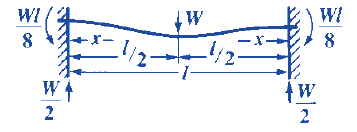
This calculator is designed to determine the beam deflection and stress equations for a beam fixed at both ends with a load applied at the center. The calculations are based on the principles of solid mechanics and the Euler-Bernoulli beam theory. The beam is assumed to be homogeneous, isotropic, and linearly elastic. By inputting the beam's dimensions, material properties, and load magnitude, users can obtain the maximum deflection, stress, and other relevant parameters. This tool is useful for engineers and designers to analyze and optimize the design of fixed-ended beams under central loading conditions. Accurate calculations are provided.
- Beam Deflection and Stress Equations Calculator for Beam Fixed at Both Ends, Load at Center
-
Calculating Beam Deflection and Stress for Fixed Beams with Central Loads
- Understanding Beam Deflection and Stress Equations
- Applications of Beam Deflection and Stress Equations Calculator
- Key Parameters in Beam Deflection and Stress Calculations
- Assumptions and Limitations of Beam Deflection and Stress Equations Calculator
- Future Developments and Improvements in Beam Deflection and Stress Equations Calculator
-
Frequently Asked Questions (FAQs)
- What is the purpose of the Beam Deflection and Stress Equations Calculator for Beam Fixed at Both Ends, Load at Center?
- How does the Beam Deflection and Stress Equations Calculator for Beam Fixed at Both Ends, Load at Center work?
- What are the limitations of the Beam Deflection and Stress Equations Calculator for Beam Fixed at Both Ends, Load at Center?
- How can I use the Beam Deflection and Stress Equations Calculator for Beam Fixed at Both Ends, Load at Center in real-world applications?
Beam Deflection and Stress Equations Calculator for Beam Fixed at Both Ends, Load at Center
The Beam Deflection and Stress Equations Calculator is a tool used to calculate the deflection and stress of a beam that is fixed at both ends and has a load applied at its! center. This calculator is useful for engineers and designers who need to determine the behavior of a beam under different loading conditions. The calculator uses the following equations to calculate the deflection and stress of the beam:
The deflection equation, which calculates the maximum deflection of the beam
The stress equation, which calculates the maximum stress of the beam
The calculator takes into account the length of the beam, the load applied at the center, the moment of inertia of the beam, and the modulus of elasticity of the material. By inputting these values, the calculator can determine the maximum deflection and stress of the beam.
Introduction to Beam Deflection and Stress
Beam deflection and stress are important considerations in the design of structures such as bridges, buildings, and machines. The deflection of a beam refers to the amount of bending or deformation that occurs when a load is applied, while the stress refers to the internal forces that are exerted on the beam as a result of the load. The calculator uses the following equations to calculate the deflection and stress of the beam:
The deflection equation: Δ = (WL^3) / (192EI)
The stress equation: σ = (WL) / (8I)
Beam Fixed at Both Ends, Load at Center
When a beam is fixed at both ends and has a load applied at its center, the deflection and stress of the beam can be calculated using the following equations:
The deflection equation: Δ = (WL^3) / (192EI)
The stress equation: σ = (WL) / (8I)
The calculator takes into account the length of the beam, the load applied at the center, the moment of inertia of the beam, and the modulus of elasticity of the material.
Calculation of Deflection and Stress
The calculation of deflection and stress involves the following steps:
1. Input the length of the beam
2. Input the load applied at the center
3. Input the moment of inertia of the beam
4. Input the modulus of elasticity of the material
5. Calculate the deflection using the equation: Δ = (WL^3) / (192EI)
6. Calculate the stress using the equation: σ = (WL) / (8I)
Importance of Beam Deflection and Stress Calculations
The calculation of beam deflection and stress is important in the design of structures because it allows engineers to determine the safety and performance of the structure. By calculating the deflection and stress of a beam, engineers can ensure that the structure will be able to withstand the loads and stresses that it will be subjected to.
Applications of Beam Deflection and Stress Calculations
The calculations of beam deflection and stress have many applications in various fields, including:
| Field | Application |
|---|---|
| Civil Engineering | Design of bridges, buildings, and other structures |
| Mechanical Engineering | Design of machines and mechanisms |
| Aerospace Engineering | Design of aircraft and spacecraft structures |
| Automotive Engineering | Design of vehicle structures and components |
| Naval Architecture | Design of ship structures and components |
By using the Beam Deflection and Stress Equations Calculator, engineers and designers can quickly and easily calculate the deflection and stress of a beam, and ensure that their designs are safe and perform as intended.
Calculating Beam Deflection and Stress for Fixed Beams with Central Loads
The calculation of beam deflection and stress is a crucial aspect of structural engineering, particularly when dealing with beams that are fixed at both ends and subjected to loads at their center. This scenario is common in various engineering applications, including building construction, bridge design, and mechanical engineering. The beam deflection and stress equations calculator is a valuable tool for engineers to determine the behavior of such beams under different load conditions. By applying the principles of mechanics of materials, engineers can use these calculators to predict the deflection, stress, and strain that a beam will experience when loaded at its center. This information is critical for ensuring the structural integrity and safety of the beam, as well as for optimizing its design to minimize material usage and costs.
Understanding Beam Deflection and Stress Equations
The beam deflection and stress equations are based on the fundamental principles of mechanics of materials, including the beam theory and the elasticity theory. These equations take into account the beam's length, cross-sectional area, moment of inertia, and material properties, such as the elastic modulus and Poisson's ratio. The deflection of a beam is calculated using the deflection equation, which is a function of the load, beam length, and beam properties. The stress in a beam is calculated using the stress equation, which is a function of the load, beam cross-sectional area, and material properties. By combining these equations, engineers can determine the maximum deflection and maximum stress that a beam will experience under a given load condition.
Applications of Beam Deflection and Stress Equations Calculator
The beam deflection and stress equations calculator has a wide range of applications in various fields of engineering, including civil engineering, mechanical engineering, and aerospace engineering. In civil engineering, this calculator is used to design and analyze building structures, bridges, and highways. In mechanical engineering, it is used to design and analyze machine components, such as shafts, gears, and bearings. In aerospace engineering, it is used to design and analyze aircraft structures, such as wings and fuselages. The calculator is also useful for research and development purposes, where engineers can use it to simulate and analyze the behavior of different beam configurations under various load conditions.
Key Parameters in Beam Deflection and Stress Calculations
Several key parameters must be considered when calculating the deflection and stress of a beam. These include the beam length, cross-sectional area, moment of inertia, material properties, and load conditions. The beam length affects the deflection and stress of the beam, with longer beams experiencing greater deflection and stress. The cross-sectional area and moment of inertia also affect the beam's deflection and stress, with larger cross-sectional areas and moments of inertia resulting in reduced deflection and stress. The material properties, such as the elastic modulus and Poisson's ratio, also play a crucial role in determining the beam's deflection and stress. Finally, the load conditions, including the load magnitude and load distribution, must be carefully considered to ensure accurate calculations.
Assumptions and Limitations of Beam Deflection and Stress Equations Calculator
The beam deflection and stress equations calculator is based on several assumptions and limitations, which must be considered when using the calculator. One major assumption is that the beam is elastic, meaning that it will return to its original shape after the load is removed. Another assumption is that the beam is prismatic, meaning that its cross-sectional area and moment of inertia are constant along its length. The calculator also assumes that the load is applied slowly and that the beam is not subjected to dynamic loads. Additionally, the calculator is limited to simple beam configurations, such as beams with a single load or uniformly distributed load. For more complex beam configurations, such as beams with multiple loads or non-uniformly distributed loads, more advanced calculation methods may be required.
Future Developments and Improvements in Beam Deflection and Stress Equations Calculator
The beam deflection and stress equations calculator is a constantly evolving tool, with ongoing research and development aimed at improving its accuracy and functionality. One area of research is the development of more advanced calculation methods, such as finite element methods and boundary element methods, which can handle more complex beam configurations and load conditions. Another area of research is the integration of the calculator with other engineering tools, such as computer-aided design (CAD) software and finite element analysis (FEA) software, to create a more seamless and integrated design and analysis process. Additionally, there is a growing interest in developing calculators that can handle dynamic loads and non-linear material behavior**, which would allow engineers to simulate and analyze the behavior of beams under more realistic and complex load conditions.
Frequently Asked Questions (FAQs)
What is the purpose of the Beam Deflection and Stress Equations Calculator for Beam Fixed at Both Ends, Load at Center?
The Beam Deflection and Stress Equations Calculator is a tool designed to calculate the deflection and stress of a beam that is fixed at both ends and subjected to a load at its center. This calculator is useful for engineers and designers who need to determine the structural integrity of a beam under various loading conditions. The calculator takes into account the material properties of the beam, such as its elastic modulus and moment of inertia, as well as the load applied to it. By using this calculator, users can quickly and easily determine the maximum deflection and stress of the beam, which is essential for ensuring the safety and performance of the structure.
How does the Beam Deflection and Stress Equations Calculator for Beam Fixed at Both Ends, Load at Center work?
The Beam Deflection and Stress Equations Calculator works by using mathematical equations to calculate the deflection and stress of the beam. The calculator first calculates the reaction forces at the fixed ends of the beam, which are equal in magnitude and opposite in direction. Then, it calculates the moment and shear diagrams of the beam, which are used to determine the maximum bending moment and shear force. The calculator then uses these values to calculate the maximum deflection and stress of the beam, using formulas such as the Euler-Bernoulli beam theory. The calculator also takes into account the boundary conditions of the beam, such as the fixed ends, to ensure that the calculations are accurate.
What are the limitations of the Beam Deflection and Stress Equations Calculator for Beam Fixed at Both Ends, Load at Center?
The Beam Deflection and Stress Equations Calculator has several limitations that users should be aware of. Firstly, the calculator assumes that the beam is subjected to a single load at its center, and does not account for multiple loads or distributed loads. Additionally, the calculator does not account for non-linear effects such as large deformations or material non-linearity. The calculator also assumes that the beam is made of a homogeneous material with isotropic properties, and does not account for anisotropic materials or composite materials. Furthermore, the calculator does not account for dynamic effects such as vibration or impact, and is only suitable for static analysis.
How can I use the Beam Deflection and Stress Equations Calculator for Beam Fixed at Both Ends, Load at Center in real-world applications?
The Beam Deflection and Stress Equations Calculator can be used in a variety of real-world applications, such as building design, civil engineering, and mechanical engineering. For example, the calculator can be used to design beams for buildings, bridges, or machinery, by determining the required material properties and dimensions to ensure safety and performance. The calculator can also be used to analyze and optimize existing beam structures, by determining the maximum deflection and stress under various loading conditions. Additionally, the calculator can be used in research and development, to investigate the behavior of new materials or innovative beam designs. By using the calculator, users can quickly and easily evaluate and compare different design options, and make informed decisions about the structural integrity of their designs.
Deja una respuesta
Entradas Relacionadas