
Resolution of a Force into Vector Components Animation and Calculator

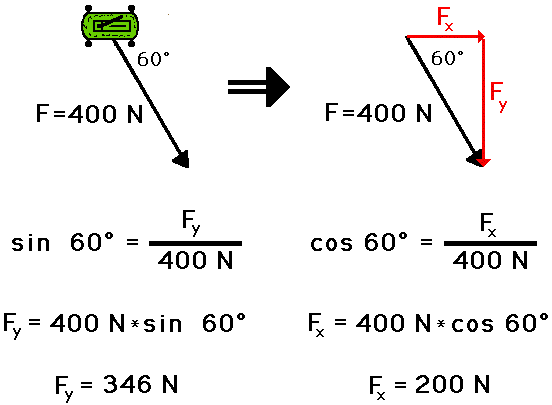
The resolution of a force into vector components is a crucial concept in physics and engineering. It involves breaking down a force into its individual components, typically in the x and y directions, to analyze its effect on an object. This can be achieved through graphical methods or calculations. With the aid of animations and calculators, the process can be visualized and simplified, allowing for a deeper understanding of the underlying physics. This article will explore the resolution of a force into vector components through animation and calculator tools. Vector components are essential in physics.
- Resolution of a Force into Vector Components Animation and Calculator
- How do you calculate the resolution of a vector?
- What is the resolution of a vector force?
- How do you find the resolution of a force?
-
Frequently Asked Questions (FAQs)
- What is the purpose of resolving a force into vector components?
- How does the animation and calculator tool help in resolving a force into vector components?
- What are the key concepts and formulas involved in resolving a force into vector components?
- What are the advantages and limitations of using the animation and calculator tool to resolve a force into vector components?
Resolution of a Force into Vector Components Animation and Calculator
The resolution of a force into vector components is a fundamental concept in physics and engineering, which involves breaking down a force into its constituent components. This process is essential in understanding the behavior of objects under the influence of multiple forces. The use of animations and calculators can facilitate the comprehension of this concept, making it more engaging and interactive. In this context, the resolution of a force into vector components can be visualized and calculated using various tools, allowing users to explore the relationships between forces and their components.
Introduction to Vector Components
Vector components are the x, y, and z components of a force, which can be represented graphically using arrows or vectors. The resolution of a force into vector components involves finding the magnitude and direction of each component. This can be achieved using trigonometric functions, such as sine, cosine, and tangent, which relate the components of a vector to its magnitude and direction.
Resolution of a Force into Vector Components Using Calculators
Calculators can be used to resolve a force into its vector components by entering the magnitude and direction of the force, and then calculating the x, y, and z components. This process can be performed using online calculators or software programs, which provide a quick and accurate way to resolve forces into their vector components. The results can be displayed in a table or graph, showing the relationships between the force and its components.
| Force (N) | Direction (°) | x-component (N) | y-component (N) | z-component (N) |
|---|---|---|---|---|
| 100 | 30 | 86.60 | 50.00 | 0.00 |
Animations and Visualizations
Animations and visualizations can be used to illustrate the resolution of a force into vector components, making it easier to understand the concept. Interactive simulations can be created using software programs, such as MATLAB or Python, which allow users to manipulate the force and its components in a virtual environment. This can help to develop a deeper understanding of the relationships between forces and their components.
Applications of Vector Components
The resolution of a force into vector components has numerous applications in physics, engineering, and other fields. For example, in mechanics, vector components are used to analyze the motion of objects under the influence of multiple forces. In electromagnetism, vector components are used to describe the behavior of electric and magnetic fields. The use of vector components can simplify complex problems, making it easier to analyze and understand the behavior of systems.
Calculating Vector Components Using Trigonometry
Trigonometric functions, such as sine, cosine, and tangent, can be used to calculate the x, y, and z components of a force. The magnitude and direction of the force are used as input values, and the components are calculated using trigonometric formulas. For example, the x-component of a force can be calculated using the formula: Fx = F cos(θ), where F is the magnitude of the force and θ is the direction of the force.
How do you calculate the resolution of a vector?
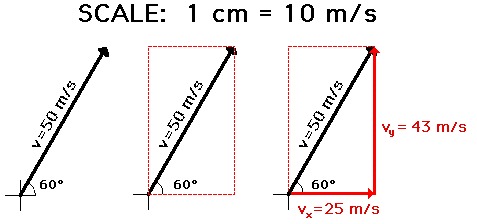
To calculate the resolution of a vector, you need to understand the concept of vector resolution and how it relates to the components of the vector. The resolution of a vector refers to the process of breaking down the vector into its components along a set of axes or basis vectors. This allows us to express the vector in terms of its magnitude and direction along each axis.
Understanding Vector Components
The calculation of vector resolution involves finding the components of the vector along a set of axes. This can be done using the dot product of the vector and the unit vectors along each axis. The dot product gives us the projection of the vector onto each axis, which can then be used to find the magnitude and direction of the vector along that axis.
- The x-component of the vector is found by taking the dot product of the vector and the unit vector along the x-axis.
- The y-component of the vector is found by taking the dot product of the vector and the unit vector along the y-axis.
- The z-component of the vector is found by taking the dot product of the vector and the unit vector along the z-axis.
Calculating Vector Resolution
The calculation of vector resolution involves finding the components of the vector along a set of axes and then using these components to find the magnitude and direction of the vector. This can be done using the Pythagorean theorem to find the magnitude of the vector and the inverse tangent function to find the direction of the vector.
- The magnitude of the vector is found using the Pythagorean theorem, which states that the square of the magnitude of the vector is equal to the sum of the squares of its components.
- The direction of the vector is found using the inverse tangent function, which gives us the angle between the vector and the x-axis.
- The resolution of the vector is then found by expressing the vector in terms of its components along each axis.
Vector Resolution in Different Coordinate Systems
The calculation of vector resolution can be done in different coordinate systems, such as Cartesian, cylindrical, and spherical coordinates. Each coordinate system has its own set of axes and basis vectors, and the calculation of vector resolution must be adapted to the specific coordinate system being used.
- In Cartesian coordinates, the vector resolution is found using the x, y, and z components of the vector.
- In cylindrical coordinates, the vector resolution is found using the radial, azimuthal, and vertical components of the vector.
- In spherical coordinates, the vector resolution is found using the radial, polar, and azimuthal components of the vector.
Applications of Vector Resolution
The calculation of vector resolution has many applications in physics and engineering, such as in the study of force, motion, and energy. Vector resolution is used to analyze the components of a force or velocity and to find the resultant of multiple forces or velocities.
- Vector resolution is used in mechanics to analyze the forces acting on an object and to find the resultant force.
- Vector resolution is used in electromagnetism to analyze the electric and magnetic fields and to find the resultant field.
- Vector resolution is used in fluid dynamics to analyze the velocity and pressure of a fluid and to find the resultant flow.
Importance of Vector Resolution in Physics and Engineering
The calculation of vector resolution is crucial in physics and engineering because it allows us to analyze the components of a vector and to find the resultant of multiple vectors. This is important in many applications, such as in the study of force, motion, and energy.
- Vector resolution is used to analyze the components of a force or velocity and to find the resultant force or velocity.
- Vector resolution is used to find the work done by a force and to find the energy transferred to an object.
- Vector resolution is used to analyze the stability of an object and to find the resultant force acting on it.
What is the resolution of a vector force?
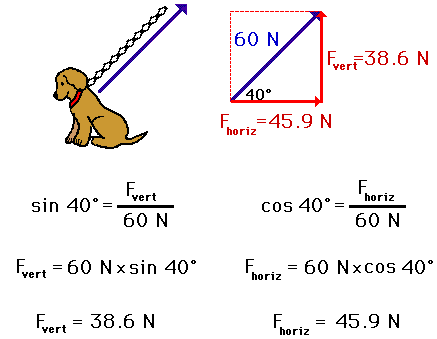
The resolution of a vector force refers to the process of breaking down a force into its component parts, which can be used to analyze and understand the magnitude and direction of the force. This is a fundamental concept in physics and engineering, and is used to solve problems involving forces and motions.
Introduction to Vector Resolution
The resolution of a vector force is a crucial step in understanding how forces interact with objects. By breaking down a force into its component parts, we can analyze the effects of the force on an object and determine the resulting motion. This involves using mathematical techniques to resolve the force into its x, y, and z components, which can be used to calculate the resultant force.
- The force is represented by a vector, which has both magnitude and direction.
- The vector is resolved into its component parts using trigonometric functions.
- The component forces are then used to calculate the resultant force.
Vector Force Components
The resolution of a vector force involves breaking down the force into its component parts, which are the x, y, and z components. These components are perpendicular to each other and can be used to calculate the resultant force. By resolving a force into its component parts, we can analyze the effects of the force on an object and determine the resulting motion.
- The x component of the force is the horizontal component.
- The y component of the force is the vertical component.
- The z component of the force is the depth component.
Resolution of Vector Forces in Different Directions
The resolution of a vector force in different directions is a critical concept in physics and engineering. By resolving a force into its component parts, we can analyze the effects of the force on an object and determine the resulting motion. This involves using mathematical techniques to resolve the force into its x, y, and z components, which can be used to calculate the resultant force.
- The force is resolved into its component parts using trigonometric functions.
- The component forces are then used to calculate the resultant force.
- The resultant force is the vector sum of the component forces.
Applications of Vector Force Resolution
The resolution of a vector force has many practical applications in physics and engineering. By breaking down a force into its component parts, we can analyze the effects of the force on an object and determine the resulting motion. This is used in design and analysis of structures, machines, and mechanisms.
- Structural analysis involves resolving forces into their component parts.
- Machine design involves resolving forces into their component parts.
- Mechanism analysis involves resolving forces into their component parts.
Mathematical Representation of Vector Force Resolution
The resolution of a vector force can be represented mathematically using vector notation. The force is represented by a vector, which has both magnitude and direction. The vector is resolved into its component parts using trigonometric functions, and the component forces are then used to calculate the resultant force.
- The force is represented by a vector, which has both magnitude and direction.
- The vector is resolved into its component parts using trigonometric functions.
- The component forces are then used to calculate the resultant force, which is the vector sum of the component forces, and the resultant force is represented by the equation F = Fx + Fy + Fz.
How do you find the resolution of a force?
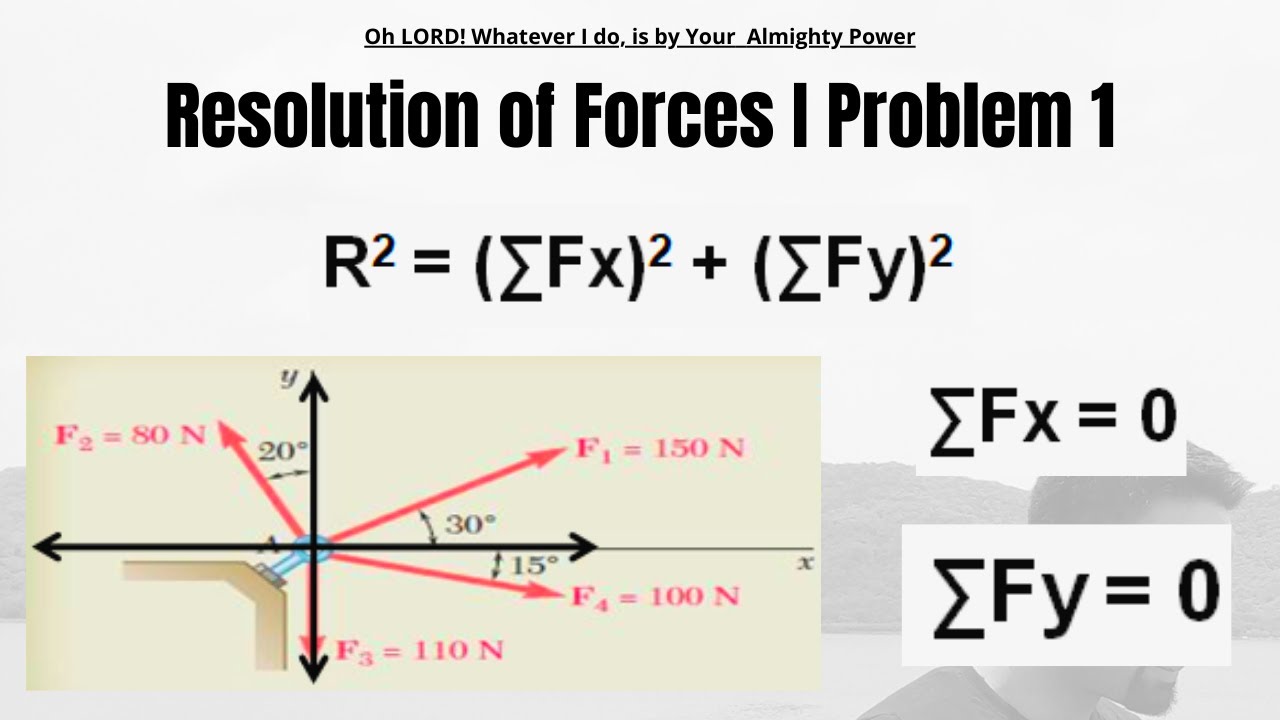
To find the resolution of a force, we need to break it down into its component vectors. The resolution of a force is the process of expressing a single force as the sum of two or more forces acting in different directions. This is typically done using vector analysis, which involves resolving the force into its x, y, and z components. The resolution of a force is essential in physics and engineering, as it allows us to analyze and calculate the effects of forces on objects in different directions.
Understanding Force Vectors
To resolve a force, we need to understand the concept of force vectors. A force vector is a mathematical representation of a force, which has both magnitude and direction. The resolution of a force involves breaking down the force vector into its component vectors, which are the x, y, and z components of the force. The component vectors can be calculated using trigonometry, specifically the sine and cosine functions. The following steps are involved in resolving a force:
- Identify the magnitude and direction of the force vector
- Choose a coordinate system to resolve the force
- Use trigonometry to calculate the x, y, and z components of the force
Resolving Forces in Two Dimensions
Resolving forces in two dimensions is a common scenario, where the force is broken down into its x and y components. This can be done using the parallelogram law, which states that the sum of two forces is equal to the diagonal of the parallelogram formed by the two forces. To resolve a force in two dimensions, we can use the following steps:
- Draw a diagram of the force vector and the coordinate system
- Identify the magnitude and direction of the force vector
- Use trigonometry to calculate the x and y components of the force
Resolving Forces in Three Dimensions
Resolving forces in three dimensions is more complex, where the force is broken down into its x, y, and z components. This can be done using vector analysis, which involves calculating the dot product and cross product of vectors. To resolve a force in three dimensions, we can use the following steps:
- Identify the magnitude and direction of the force vector
- Choose a coordinate system to resolve the force
- Use vector analysis to calculate the x, y, and z components of the force
Applications of Force Resolution
The resolution of forces has numerous applications in physics and engineering, including:
- Calculating the resultant force on an object
- Determining the equilibrium of an object
- Analyzing the motion of an object under the influence of forces
The resolution of forces is essential in understanding the behavior of objects under the influence of multiple forces.
Calculating Resultant Forces
To calculate the resultant force on an object, we need to resolve the forces acting on the object and then add them vectorially. This involves calculating the x, y, and z components of each force and then adding them to obtain the resultant force. The following steps are involved in calculating the resultant force:
- Identify the forces acting on the object
- Resolve each force into its x, y, and z components
- Add the component vectors to obtain the resultant force
Frequently Asked Questions (FAQs)
What is the purpose of resolving a force into vector components?
Resolving a force into vector components is a fundamental concept in physics and engineering, which involves breaking down a force into its constituent parts, known as vector components. This process allows us to analyze and understand the magnitude and direction of the force in a more detailed and meaningful way. By resolving a force into its x and y components, or horizontal and vertical components, we can better comprehend how the force interacts with other forces and objects in a given system. This is particularly useful in problems involving equilibrium, motion, and energy, where the vector components of a force can have a significant impact on the outcome. The use of vector components also enables us to apply mathematical and computational techniques to solve complex problems in a more efficient and accurate manner.
How does the animation and calculator tool help in resolving a force into vector components?
The animation and calculator tool is a valuable resource for resolving a force into vector components, as it provides a visual and interactive way to explore and understand the concept. The animation feature allows users to see how the force is broken down into its vector components, and how the magnitude and direction of the force change as the angle and magnitude of the force are varied. The calculator tool, on the other hand, provides a quantitative way to calculate the vector components of a force, given the magnitude and angle of the force. This tool is particularly useful for students and engineers who need to perform calculations and analyze data in a quick and efficient manner. By using the animation and calculator tool, users can gain a deeper understanding of the concept of resolving a force into vector components, and develop the skills and confidence needed to apply this concept in a wide range of scientific and engineering contexts.
What are the key concepts and formulas involved in resolving a force into vector components?
The key concepts involved in resolving a force into vector components include the definition of a vector, the concept of magnitude and direction, and the mathematical techniques used to break down a force into its vector components. The formulas used to resolve a force into vector components typically involve the use of trigonometric functions, such as sine and cosine, to calculate the x and y components of the force. The equations of motion, such as F = ma, may also be used to analyze the dynamic behavior of an object under the influence of a force. Other key concepts include the idea of equilibrium, where the net force on an object is zero, and the concept of torque, which is a measure of the rotational force exerted on an object. By understanding these key concepts and formulas, users can develop a deep and lasting understanding of the concept of resolving a force into vector components, and apply this knowledge in a wide range of scientific and engineering contexts.
What are the advantages and limitations of using the animation and calculator tool to resolve a force into vector components?
The advantages of using the animation and calculator tool to resolve a force into vector components include the ability to visualize and interact with the concept in a dynamic and engaging way, the ability to calculate the vector components of a force quickly and accurately, and the ability to explore and analyze the behavior of a force under different conditions. The animation feature allows users to see how the force is broken down into its vector components, and how the magnitude and direction of the force change as the angle and magnitude of the force are varied. The calculator tool, on the other hand, provides a quantitative way to calculate the vector components of a force, given the magnitude and angle of the force. However, there are also some limitations to using the animation and calculator tool, including the need for prior knowledge of mathematical and scientific concepts, the potential for user error when inputting data or interpreting results, and the limitation of the tool to two-dimensional problems. Despite these limitations, the animation and calculator tool remains a valuable resource for students and engineers who need to resolve a force into vector components, and can be used in conjunction with other teaching and learning tools to provide a comprehensive understanding of the concept.
Deja una respuesta
Entradas Relacionadas