
Volts to dBm Equation and Calculator

The conversion from volts to decibel-milliwatts (dBm) is a crucial calculation in various fields, including electrical engineering, telecommunications, and physics. It allows for the representation of power levels in a more manageable and comparable format. The equation for converting volts to dBm involves the use of a reference resistance and the voltage measured across it. This article provides an in-depth look at the equation and offers a calculator to simplify the conversion process, making it easier to work with different voltage and power levels in various applications and systems. The equation is a fundamental tool.
Converting Volts to dBm: Understanding the Equation and Calculator
The conversion of voltage to dBm (decibel-milliwatts) is a fundamental concept in electrical engineering, particularly in the field of telecommunications and signal processing. This conversion is crucial for understanding the strength of a signal, which is essential for designing and optimizing communication systems. The Volts to dBm equation is used to calculate the power of a signal in dBm when the voltage and impedance are known.
Understanding the Volts to dBm Equation
The Volts to dBm equation is given by: dBm = 10 log10((V^2 / R) / 0.001), where V is the voltage in volts, R is the resistance in ohms, and 0.001 is the reference power in watts. This equation allows engineers to convert voltage measurements into a more meaningful representation of signal power, which can be used to evaluate system performance.
Using a Volts to dBm Calculator
A Volts to dBm calculator is a tool used to simplify the conversion process. It takes the voltage and impedance as input and outputs the corresponding power in dBm. These calculators can be found online or built into software tools used for signal analysis and system design. They save time and reduce errors associated with manual calculations.
Applications of Volts to dBm Conversion
The conversion of volts to dBm has numerous applications in telecommunications, audio engineering, and other fields involving signal transmission and processing. For instance, in wireless communication systems, understanding the signal strength in dBm is crucial for ensuring reliable data transmission and reception. Similarly, in audio systems, converting voltage to dBm helps in evaluating the power of audio signals, which is vital for optimizing sound quality.
Importance of Impedance in Volts to dBm Conversion
Impedance plays a critical role in the conversion of volts to dBm. The equation requires knowledge of the resistance (or impedance in the case of AC circuits) against which the voltage is measured. Incorrect impedance values can lead to significant errors in the calculated dBm value, affecting the accuracy of system evaluations and designs.
Challenges and Considerations
There are several challenges and considerations when converting volts to dBm, including the need for accurate voltage and impedance measurements, understanding the reference conditions for the conversion (such as the reference power of 1 mW), and being aware of the potential for error due to non-ideal circuit conditions. Additionally, the conversion assumes a specific load impedance, typically 50 ohms in RF systems, which must be matched for accurate calculations.
| Voltage (V) | Impedance (R) | Power (dBm) |
|---|---|---|
| 1 | 50 | 13.01 |
| 2 | 50 | 16.02 |
| 5 | 50 | 23.52 |
Can you convert volts to dBm?
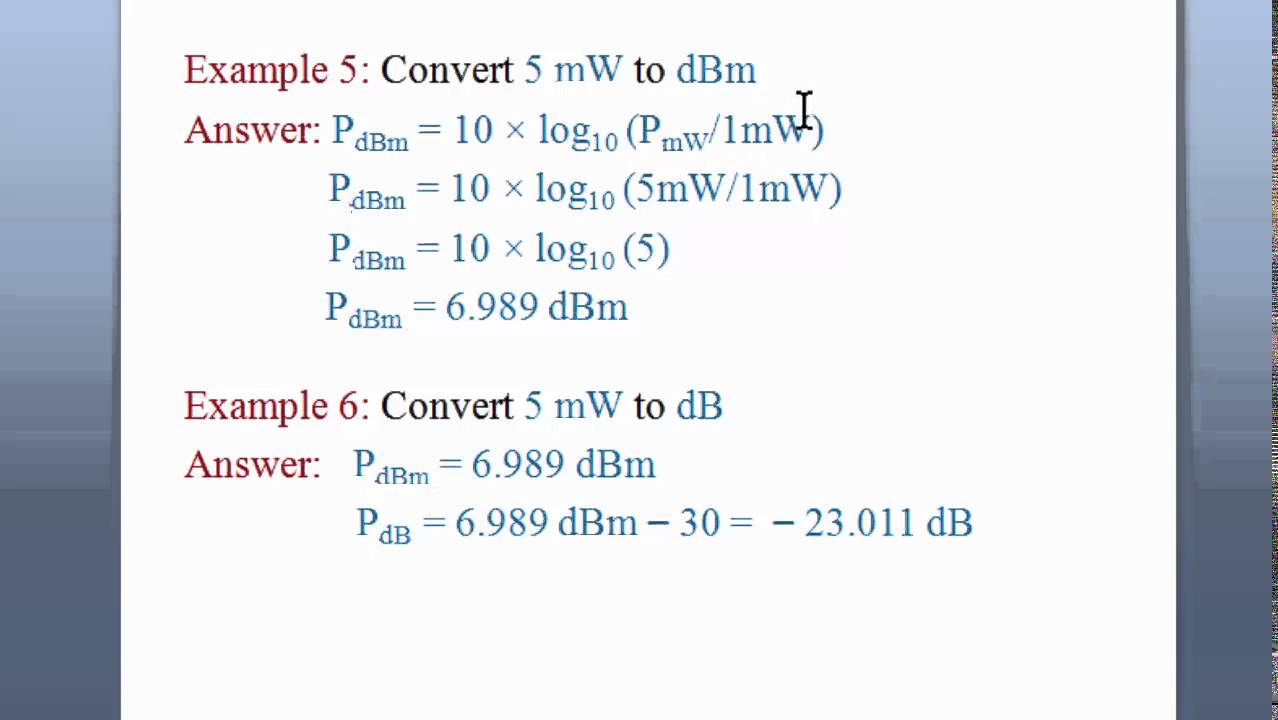
To convert volts to dBm, you can use the formula: dBm = 10 log10((V^2 / R) / 0.001), where V is the voltage in volts, R is the resistance in ohms, and 0.001 is the reference power in watts. This formula is based on the definition of dBm as the power in decibels relative to 1 milliwatt.
Understanding the Conversion Formula
The conversion formula from volts to dBm involves squaring the voltage and dividing it by the resistance. This is because power is proportional to the square of the voltage, and the resistance determines how much power is delivered to a load. The formula also includes a reference power of 0.001 watts, which is equivalent to 1 milliwatt. The log10 function is used to convert the ratio of powers to decibels.
- The formula assumes a resistance of 50 ohms, which is a common value in communications systems.
- The voltage must be in volts RMS (root mean square) for the formula to be applicable.
- The decibel scale is logarithmic, which means that a small change in power corresponds to a large change in dBm.
Applications of Volts to dBm Conversion
The conversion from volts to dBm is commonly used in communications systems, such as radio frequency (RF) and microwave systems. It is also used in audio systems, where the power of an audio signal needs to be measured. In addition, the conversion is used in test and measurement equipment, such as spectrum analyzers and signal generators.
- In RF systems, the conversion is used to measure the power of a signal at different points in the system.
- In audio systems, the conversion is used to measure the power of an audio signal and to set the gain of amplifiers and attenuators.
- In test and measurement equipment, the conversion is used to measure the power of a signal and to display it in dBm.
Importance of Reference Resistance
The reference resistance is an important parameter in the conversion from volts to dBm. The reference resistance determines the power that is delivered to a load, and it is used to calculate the dBm value. A common value for the reference resistance is 50 ohms, which is widely used in communications systems.
- The reference resistance is typically specified in the data sheet of a device or system.
- The reference resistance can be different for different devices or systems, so it is essential to use the correct value when converting from volts to dBm.
- If the reference resistance is not specified, it is often assumed to be 50 ohms, but this can lead to errors if the actual reference resistance is different.
Limitations of the Conversion Formula
The conversion formula from volts to dBm has some limitations. It assumes a resistance of 50 ohms, which may not always be the case. Additionally, the formula does not take into account the impedance of the load, which can affect the power that is delivered.
- The formula assumes a linear relationship between the voltage and the power, which may not be true for all devices or systems.
- The formula does not account for losses in the system, such as cable losses or connector losses.
- The formula is only applicable for sinusoidal signals, and it may not be accurate for non-sinusoidal signals.
Practical Considerations for Conversion
When converting from volts to dBm, there are some practical considerations to keep in mind. The voltage must be measured accurately, and the reference resistance must be known. Additionally, the conversion formula must be applied correctly, taking into account any losses or non-linearities in the system.
- The voltage must be measured using a high-impedance voltmeter to avoid loading the circuit.
- The reference resistance must be specified in the data sheet of the device or system.
- The conversion formula must be applied using a calculator or computer program to ensure accuracy.
What is the formula for calculating dBm?

The formula for calculating dBm (decibel-milliwatts) is: dBm = 10 log10(P / 0.001), where P is the power in watts. This formula is used to express the power of a signal in a more convenient and expressive way, especially when dealing with very small or very large power values.
Understanding the dBm Unit
The dBm unit is a measure of power in a signal. It is widely used in telecommunications and electronics to express the strength of a signal. The formula takes into account the reference power of 1 milliwatt (0.001 watts), which is the standard reference point for dBm calculations. The key points to understand about dBm are:
- It is a logarithmic unit, which means that it represents the power of a signal on a logarithmic scale.
- The reference power is 1 milliwatt, which is a relatively small amount of power.
- dBm values can be positive or negative, depending on whether the power is greater than or less than the reference power.
Calculating dBm from Watts
To calculate dBm from watts, you can use the formula: dBm = 10 log10(P / 0.001), where P is the power in watts. This formula allows you to convert a power value in watts to a dBm value. The key steps to calculate dBm from watts are:
- Convert the power value to watts if it is not already in watts.
- Divide the power value by the reference power of 0.001 watts.
- Take the logarithm of the result using base 10.
Applications of dBm in Telecommunications
dBm is widely used in telecommunications to express the signal strength of a transmitted signal. It is an important parameter in wireless communication systems, such as cellular networks and Wi-Fi networks. The key applications of dBm in telecommunications are:
- Signal strength measurement: dBm is used to measure the strength of a signal at a particular point in a network.
- Power control: dBm is used to control the power of a signal to ensure that it is within a certain range.
- Interference management: dBm is used to manage interference between different signals in a network.
dBm vs dB: What's the Difference?
dBm and dB are both units of measurement for power, but they have different reference points. dBm is referenced to 1 milliwatt, while dB is referenced to a variable power level. The key differences between dBm and dB are:
- Reference point: dBm has a fixed reference point of 1 milliwatt, while dB has a variable reference point.
- Scale: dBm is a logarithmic scale, while dB is also a logarithmic scale but with a different reference point.
- Application: dBm is widely used in telecommunications, while dB is widely used in audio and acoustics.
Common dBm Values and Their Meanings
dBm values can range from very low to very high, depending on the power level of the signal. Some common dBm values and their meanings are:
- 0 dBm: This is the reference power of 1 milliwatt.
- 10 dBm: This is a power level of 10 milliwatts, which is 10 times the reference power.
- -10 dBm: This is a power level of 0.1 milliwatts, which is 1/10th of the reference power.
What is the formula for converting power to dBm?

The formula for converting power to dBm is given by:
dBm = 10 log10(P / 0.001), where P is the power in watts. This formula is commonly used in telecommunications and electronics to express power levels in a more convenient and intuitive way.
Understanding the Formula
The formula to convert power to dBm involves a logarithmic function, which allows for a more compact representation of large ranges of power values. To apply this formula, you need to know the power in watts and then divide it by 0.001 (which is equivalent to 1 milliwatt) before taking the base-10 logarithm and multiplying by 10. The result is the power level in dBm. Some key points to consider when using this formula include:
- Ensure the power is in watts before applying the formula.
- Divide the power by 0.001 to normalize it to dBm.
- Take the base-10 logarithm of the normalized power.
Applications of dBm in Telecommunications
dBm is widely used in telecommunications to express the power levels of signals. This unit is particularly useful because it provides a way to describe both very large and very small power levels in a convenient and intuitive manner. For example, in the context of wireless communication, the power of the signal received by a mobile device might be expressed in dBm to indicate its strength. Some benefits of using dBm in telecommunications include:
- Easy comparison of signal strengths.
- Standardization across different communication systems.
- Simplified calculations involving power levels.
Calculating dBm from Different Power Units
When the power is given in units other than watts, it must first be converted to watts before applying the formula to convert it to dBm. For instance, if the power is given in milliwatts, it can be converted to watts by dividing by 1000. Then, the standard formula can be applied to find the dBm value. Key considerations when converting from other power units include:
- Conversion factors between different units of power.
- Accuracy in the conversion process.
- Consistency in using the same units throughout calculations.
Converting dBm Back to Power
To convert dBm back to power in watts, the inverse of the original formula is used: P = 0.001 10^(dBm / 10). This process involves exponentiation to reverse the logarithmic operation used in the initial conversion to dBm. Some points to note when converting back to power include:
- Exponentiation is the inverse operation of logarithm.
- Precise calculation is crucial to avoid errors.
- Unit consistency must be maintained throughout the calculation.
Importance of dBm in Electronic Design
In electronic design, the use of dBm as a unit of power is crucial for several reasons. It allows designers to easily compare and calculate power levels, which is essential for ensuring the reliability and efficiency of electronic circuits. Additionally, dBm is used in amplifier and filter design to determine gain and attenuation levels. Some key benefits of using dBm in electronic design include:
- Simplified design processes through the use of standardized units.
- Improved accuracy in calculations involving power levels.
- Enhanced performance of electronic devices by optimizing power levels.
How to convert vrms to dBm?
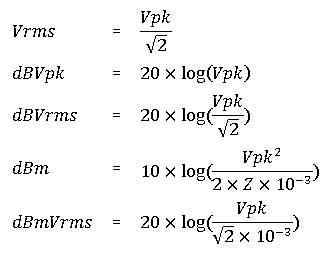
To convert VRMS (Voltage Root Mean Square) to dBm (Decibel-millijoules), you need to use the formula: dBm = 10 log10((VRMS^2 / R) / 0.001). Here, R is the resistance in ohms and 0.001 is the reference power in watts.
Understanding the Formula
The formula to convert VRMS to dBm involves squaring the VRMS value, dividing it by the resistance, and then taking the logarithm of the result. This formula is based on the definition of dBm, which is a unit of power relative to one milliwatt. The VRMS value represents the root mean square voltage, which is a measure of the voltage level. The resistance is typically 50 ohms for RF and microwave applications.
- First, calculate the power in watts by squaring the VRMS value and dividing it by the resistance.
- Then, divide the result by the reference power of 0.001 watts.
- Finally, take the logarithm of the result and multiply it by 10 to get the value in dBm.
Importance of Resistance
The resistance value is critical in the conversion formula because it determines the power level. A higher resistance results in a lower power level, while a lower resistance results in a higher power level. Typically, a resistance of 50 ohms is used for RF and microwave applications, but this value can vary depending on the specific application.
- For example, in a 50-ohm system, a VRMS of 1 volt corresponds to a power level of 20 dBm.
- In contrast, in a 75-ohm system, the same VRMS of 1 volt corresponds to a power level of 18.75 dBm.
- Therefore, it is essential to know the resistance value when converting VRMS to dBm.
Applications of Conversion
The conversion from VRMS to dBm is commonly used in various applications, including wireless communication systems, audio equipment, and test and measurement instruments. In these applications, it is often necessary to express the signal level in terms of dBm to ensure compatibility and to facilitate comparisons.
- For instance, in wireless communication systems, the signal strength is often measured in dBm.
- In audio equipment, the signal level is often expressed in dBm to ensure optimal performance.
- In test and measurement instruments, the conversion from VRMS to dBm is used to measure the power level of signals.
Common Mistakes to Avoid
When converting VRMS to dBm, there are several common mistakes to avoid, including using the wrong resistance value, failing to square the VRMS value, and not accounting for the reference power level. These mistakes can result in inaccurate conversions and can lead to system errors or equipment damage.
- For example, using a resistance value of 75 ohms instead of 50 ohms can result in an error of several dB.
- Failing to square the VRMS value can result in an error of up to 6 dB.
- Not accounting for the reference power level can result in an error of up to 30 dB.
Tools and Software for Conversion
There are several tools and software available that can perform the conversion from VRMS to dBm, including spreadsheet programs, calculation software, and online converters. These tools can simplify the conversion process and reduce the risk of errors.
- For example, Microsoft Excel can be used to create a spreadsheet that performs the conversion.
- MATLAB is a software that can be used to perform complex calculations, including the conversion from VRMS to dBm.
- Online converters are available that can perform the conversion with a simple input of the VRMS value and resistance.
Frequently Asked Questions (FAQs)
What is the Volts to dBm Equation and Calculator used for?
The Volts to dBm Equation and Calculator is a tool used to convert voltage measurements into decibel-milliwatts (dBm), which is a unit of measurement for power levels. This conversion is crucial in various fields, including telecommunications, electrical engineering, and audio engineering. The equation and calculator provide a convenient way to calculate the dBm value from a given voltage measurement, taking into account the resistance and impedance of the circuit. By using the Volts to dBm Equation and Calculator, users can easily determine the power level of a signal in dBm, which is essential for designing, testing, and troubleshooting various systems, such as amplifiers, transmitters, and receivers.
How does the Volts to dBm Equation and Calculator work?
The Volts to dBm Equation and Calculator works by using the formula: dBm = 10 log10 (V^2 / (R 1000)), where V is the voltage measurement in volts, R is the resistance in ohms, and 1000 is a constant that represents the reference impedance. By plugging in the values of V and R, the calculator can determine the dBm value. The equation takes into account the relationship between voltage, current, and power, allowing users to convert between these different quantities. The calculator provides a user-friendly interface for entering the input values and obtaining the calculated dBm value. Additionally, the calculator may also provide additional features, such as unit conversions and error checking, to ensure accurate and reliable results.
What are the key benefits of using the Volts to dBm Equation and Calculator?
The Volts to dBm Equation and Calculator offers several key benefits, including convenience, accuracy, and speed. By providing a simple and straightforward way to convert voltage measurements to dBm, the calculator saves users time and effort that would be required to perform manual calculations. Additionally, the calculator reduces the risk of errors and inaccuracies that can occur when using manual calculation methods. The equation and calculator also provide a consistent and reliable way to perform conversions, which is essential for ensuring accuracy and repeatability in various applications. Furthermore, the Volts to dBm Equation and Calculator can be used in a wide range of fields and industries, making it a versatile and valuable tool for engineers, technicians, and researchers.
What are some common applications of the Volts to dBm Equation and Calculator?
The Volts to dBm Equation and Calculator has a wide range of applications in various fields and industries, including telecommunications, audio engineering, electrical engineering, and research. In telecommunications, the calculator is used to determine the power level of signals transmitted over communication systems, such as cellular networks and satellite communications. In audio engineering, the calculator is used to measure the power level of audio signals, which is essential for designing and optimizing audio systems, such as public address systems and recording studios. The calculator is also used in electrical engineering to determine the power level of electrical signals, which is critical for designing and testing electrical systems, such as power grids and electrical circuits. Additionally, the Volts to dBm Equation and Calculator is used in research applications, such as materials science and physics, to measure the power level of signals in various experiments and studies.
Deja una respuesta
Entradas Relacionadas